
art in all its forms

2/19/11


The Kids Are All Right But Not The King's Speech
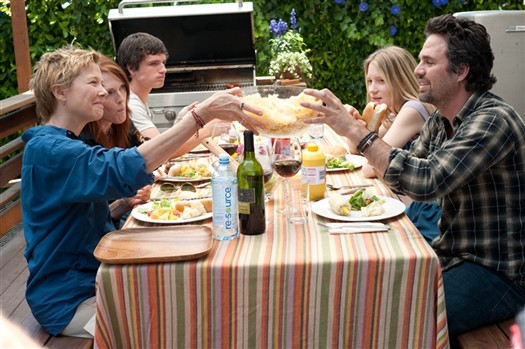
The Kids Are All Right has a cool title. All right as in a concession to the fact that children come first and are always right? All right as in they turned out okay? All right as in all from the right wing, conservative camp?
Lisa Cholodenko's film is a gently humourous melodrama that is something of a political statement without overtly being one. It's something of a miracle that this small film got nominated for Best Picture. Catherine Shoard of the UK Guardian is convinced the film has not a chance in hell (SEE this) of winning, though.
The movie is great because, finally, it's a gay film in which nobody dies. This is a daring feat in itself (consider Philadelphia: Tom Hanks dies of AIDS after listening to opera with Denzil Washington; Brokeback Mountain: Jake Gyllenhaal is murdered in the desert leaving Heath Ledger to sniff Jake's bloody shirt to get high; Kiss of the Spider Woman: John Hurt gets killed after going Latino in prison, Milk: Sean Penn finally wins the Oscar for getting assassinated after bedding James Franco etc etc).
The plot concerns a lesbian couple and one hot sperm donor. There are some twists that are almost parodies of cliches involving lesbians. But let's not get into that too much. It's straight-forward, life-affirming melodrama.

Which is pretty much what The King's Speech is. The film is about King George VI learning not to stammer and the awful life of being royal. This is inherently fascinating stuff. There is a really bad cameo by Timothy Spall as Winston Churchill though. And its take on history is misleading. Its a good production and beautiful to look at but it's not the best film of 2010.


2/13/11
FILM REVIEW: True Grit

True Grit is a better movie than you expect it to be. And it's truly great.
It's not a remake but rather a reboot. A second adaptation of a 1968 bildungsroman by Charles Portis.
At first blush, this is not material you expect to be a right fit for the Cohen brothers (No Country for Old Men, Fargo).
There's Jeff Bridges in an eye-patch-wearing role first taken up by John Wayne. Bridges does not play Wayne here. He's Jeff Bridges playing Rooster Cogburn, a boozy hired vigilante with an apparent soft spot for little girls.
Also with a soft spot for little girls is Matt Damon, playing LaBoeuf, who, with Cogburn, hunt down the murderer of Hailee Steinfeld's dad. There are enough Freudian impulses going on here to easily take over what could have been a simple wild wild American west movie. Instead, the Cohen brothers go for edge, for character, beauty, intensity and, ultimately, the bittersweet and sublime.
It's like No Country for Old Men but with spanking! Unmissable.
FOUR STARS: ****
BEDSIDE BOOKS: From 'Running the Dusk' by Christian Campbell

A quick round-up of books am dipping into at the moment discloses: Plan B by Paul Muldoon (photometry with photographs by Norman McBeath), Selected Poems by Sylvia Plath, Running the Dusk by Christian Campbell (which was shortlisted for the Forward Prize for best first book of 2010); The Four Questions of Melancholy by Tomaž Šalamun (because five questions would have been intolorable); Veil by Bob Woodward (the story of the CIA's secret wars of the 1980s); Art in the Caribbean by Anne Walmsley and Sybil by Benjamin Disreali.
Here is a poem from Campbell's Running the Dusk which can be found at the publisher's website:
Iguana
for A.T.
My friend from Guyana
was asked in Philadelphia
if she was from “Iguana.”
Iguana, which crawls and then
stills, which flicks its tongue at the sun.
In History we learned that Lucayans
ate iguana, that Caribs
(my grandmother’s people)
ate Lucayans (the people of Guanahani).
Guiana (the colonial way,
with an i, southernmost
of the Caribbean) is iguana; Inagua
(southernmost of The Bahamas,
northernmost of the Caribbean)
is iguana— Inagua, crossroads with Haiti,
Inagua of the salt and flamingos.
The Spanish called it Heneagua,
“water is to be found there,”
water, water everywhere.
Guyana (in the language of Arawaks,
Wai Ana, “Land of Many Waters”)
is iguana, veins running through land,
grooves between green scales.
My grandmother from Moruga
(southern-most in Trinidad)
knew the names of things.
She rubbed iguana with bird pepper,
she cooked its sweet meat.
The earth is on the back
of an ageless iguana.
We are all from the Land of Iguana,
Hewanorra, Carib name for St. Lucia.
And all the iguanas scurry away from me.
And all the iguanas are dying.
READ MORE in this interview with Campbell at the Caribbean Review of Books here. And just to throw something else in I must share this poem by Plath which is one of my favorites:
Mirror
I am silver and exact. I have no preconceptions.
Whatever I see, I swallow immediately.
Just as it is, unmisted by love or dislike
I am not cruel, only truthful –
The eye of a little god, four-cornered.
Most of the time I meditate on the opposite wall.
It is pink, with speckles. I have looked at it so long
I think it is a part of my heart. But it flickers.
Faces and darkness separate us over and over.
Now I am a lake. A woman bends over me.
Searching my reaches for what she really is.
Then she turns to those liars, the candles or the moon.
I see her back, and reflect it faithfully
She rewards me with tears and an agitation of hands.
I am important to her. She comes and goes.
Each morning it is her face that replaces the darkness.
In me she has drowned a young girl, and in me an old woman
Rises toward her day after day, like a terrible fish.
I am silver and exact. I have no preconceptions.
Whatever I see, I swallow immediately.
Just as it is, unmisted by love or dislike
I am not cruel, only truthful –
The eye of a little god, four-cornered.
Most of the time I meditate on the opposite wall.
It is pink, with speckles. I have looked at it so long
I think it is a part of my heart. But it flickers.
Faces and darkness separate us over and over.
Now I am a lake. A woman bends over me.
Searching my reaches for what she really is.
Then she turns to those liars, the candles or the moon.
I see her back, and reflect it faithfully
She rewards me with tears and an agitation of hands.
I am important to her. She comes and goes.
Each morning it is her face that replaces the darkness.
In me she has drowned a young girl, and in me an old woman
Rises toward her day after day, like a terrible fish.

1/23/11
Art. Recognition. Culture.

Introducing ARC. SEE website here. READ CRB blog piece with ARC's editor in chief Holly Bynoe and the magazine's creative director Nadia Huggins here.
FROM THE ARC website:
ARC Magazine is a quarterly Caribbean Art and Culture print and e-magazine published out of St. Vincent and the Grenadines by artists Nadia Huggins and Holly Bynoe. We are endeavouring to form a creative platform to offer insight into current practices across the burgeoning creative industries, while bridging the gap between established and emerging artists. Within the recent motions of integration there is a critical space developing where, for the first time, we can envision a converging nexus of artists who want to share their creative experience.
ARC Magazine presents a formula, an experiment and an imaginative body of curated work that exhibits the trajectory and the motion of artists who practice within the region. Within our collective networks, we are finding it necessary to make the common man and the aficionado aware of possibility of art, its evolution, trends and ‘personalities’. We also feel the need to provide a forum that celebrates creativity, its determination, dialogue and pleasure. It is our ambition to inspire and give voice to a new generation of independent, DIY and emerging artists who remain fearless while battling the parts, fractions and whole of their varied cultures. At ARC we want artists to negotiate their own space by offering a neutral ground that will license discourse and varied creative insights into the mind of an artist.
ARC is a projected motion that goes up, outwards and beyond into a space of curiosity.
Wrestling with the Image

SEE RICHARD RAWLINS E-CAT here.
The Art Museum of the Americas (AMA) announces the opening of Wrestling with the Image: Caribbean Interventions, an exhibition of contemporary art from twelve Caribbean countries. Featuring work by artists from the Bahamas, Barbados, Belize, Dominica, Guyana, Haiti, Jamaica, Saint Kitts and Nevis, Saint Lucia, Saint Vincent and the Grenadines, Suriname, and Trinidad and Tobago, the exhibition is curated by artist and curator Christopher Cozier and art historian Tatiana Flores.
Wrestling with the Image: Caribbean Interventions presents works in a variety of media, including photography, video, painting, graphic arts, sculpture, and installation. The scope of the objects demonstrates how the region’s contemporary artists are confronting stereotypes about the Caribbean without denying their own surroundings or rejecting the worlds in which they operate. Through investigations on history, tourism, globalization, popular culture, and gender, these artists urge us to reconsider our own expectations on how a Caribbean image should look.
Characterized by scholars as “the laboratory of globalization,” the Caribbean is a multifaceted locale that transcends geographic boundaries. Its culture has European, African, Asian, Latin American, and Native American roots. It is not surprising, then, that several artists in the exhibition explore themes of migration, the spread of culture, and global citizenship. For co-curator Christopher Cozier, “this is a conversation about movement in the Atlantic world—a dialogue about dispersal rather than displacement.” Many of the artists themselves no longer live in the Caribbean, residing in the United States, Canada, Europe, and Asia; nevertheless, their experiences are the result of complex historical, economic, and cultural processes that are part and parcel of what it means to be Caribbean.
Past and present, local and universal, and self and other are among the dichotomies addressed in this exhibition. Marlon James’ blunt and direct portraits depict young people who look like they could be from anywhere. Ebony Patterson’s provocative portrayals derived from Jamaican dancehall culture—with its ironic face bleaching and androgynous fashions—are equally global. By contrast, Joscelyn Gardner engages the historical archive. Her series of hand-painted stone lithographs Creole Portraits III pays tribute to faceless women victims of slavery by depicting a typical African hairstyle juxtaposed to an iron collar. Among other images conjuring colonial history is Nikolai Noel’s drawing Toussaint et George, in which Haitian liberator Toussaint L’Ouverture and George Washington seem to stare each other down on equal footing.
In John Cox’ paintings of boxers, the notion of the prize fighter as confident and infallibly masculine is turned on its side. The works introduce unresolved tensions by depicting subjects fighting against their doppelgangers or striking their own faces. Heino Schmid challenges that status of the image as a conveyor of meaning. In the case of his Temporary Horizon video, two glass bottles momentarily keep one another standing, but then fall. A man’s arms and waist appear on screen, and he puts the bottles back into place. They fall again, and the anonymous man’s Sisyphean task continues.
As a group, the works in the exhibition demonstrate the dynamism and creativity of the current generation of Caribbean artists. According to co-curator Tatiana Flores, they also “allow us to reflect on our own assumptions and preconceptions regarding the meaning of place, the articulation of difference, and the construction of past and present. Whether they challenge, delight, frustrate, or disgust, these images provoke a reaction.”
Wrestling with the Image: Caribbean Interventions includes work by John Cox, Blue Curry, Kishan Munroe, Heino Schmid, (The Bahamas); Ewan Atkinson, Joscelyn Gardner, Sheena Rose, Tonya Wiles (Barbados); Santiago Cal (Belize); Pauline Marcelle (Dominica); Roshini Kempadoo, Hew Locke (Guyana); Maksaens Denis, Jean-Ulrick Désert, Barbara Prézeau-Stephenson (Haiti); Charles Campbell, Keisha Costello, Marlon James, Ebony Patterson, Oneika Russell, Phillip Thomas (Jamaica); Terry Boddie (Saint Kitts and Nevis); Nadia Huggins, (Saint Lucia); Holly Bynoe, (Saint Vincent and the Grenadindes); Sri Irodikromo, Patricia Kaersenhout, Marcel Pinas, Dhiradj Ramsamoedj, (Suriname); Nicole Awai, La Vaughn Belle, Marlon Griffith, Jaime Lee Loy, Richard Fung, Abigail Hadeed, Nikolai Noel, Rodell Warner, and Natalie Wood (Trinidad and Tobago).
Wrestling with the Image: Caribbean Interventions forms part of the About Change emerging artists’ program, an initiative of the World Bank in partnership with the Inter-American Development Bank, the OAS, and the Caribbean Community (CARICOM) Secretariat. About Change is a series of juried exhibitions of contemporary art from Latin America and the Caribbean that will take place throughout 2011 and 2012 at different venues in Washington, D.C., including the World Bank, the Art Museum of the Americas, and the galleries of the Inter-American Development Bank. It has been organized by the World Bank Art Program under the auspices of the World Bank Vice Presidency for Latin America and the Caribbean Region.
Art Museum of the Americas
The Art Museum of the Americas (AMA) announces the opening of Wrestling with the Image: Caribbean Interventions, an exhibition of contemporary art from twelve Caribbean countries. Featuring work by artists from the Bahamas, Barbados, Belize, Dominica, Guyana, Haiti, Jamaica, Saint Kitts and Nevis, Saint Lucia, Saint Vincent and the Grenadines, Suriname, and Trinidad and Tobago, the exhibition is curated by artist and curator Christopher Cozier and art historian Tatiana Flores.
Wrestling with the Image: Caribbean Interventions presents works in a variety of media, including photography, video, painting, graphic arts, sculpture, and installation. The scope of the objects demonstrates how the region’s contemporary artists are confronting stereotypes about the Caribbean without denying their own surroundings or rejecting the worlds in which they operate. Through investigations on history, tourism, globalization, popular culture, and gender, these artists urge us to reconsider our own expectations on how a Caribbean image should look.
Characterized by scholars as “the laboratory of globalization,” the Caribbean is a multifaceted locale that transcends geographic boundaries. Its culture has European, African, Asian, Latin American, and Native American roots. It is not surprising, then, that several artists in the exhibition explore themes of migration, the spread of culture, and global citizenship. For co-curator Christopher Cozier, “this is a conversation about movement in the Atlantic world—a dialogue about dispersal rather than displacement.” Many of the artists themselves no longer live in the Caribbean, residing in the United States, Canada, Europe, and Asia; nevertheless, their experiences are the result of complex historical, economic, and cultural processes that are part and parcel of what it means to be Caribbean.
Past and present, local and universal, and self and other are among the dichotomies addressed in this exhibition. Marlon James’ blunt and direct portraits depict young people who look like they could be from anywhere. Ebony Patterson’s provocative portrayals derived from Jamaican dancehall culture—with its ironic face bleaching and androgynous fashions—are equally global. By contrast, Joscelyn Gardner engages the historical archive. Her series of hand-painted stone lithographs Creole Portraits III pays tribute to faceless women victims of slavery by depicting a typical African hairstyle juxtaposed to an iron collar. Among other images conjuring colonial history is Nikolai Noel’s drawing Toussaint et George, in which Haitian liberator Toussaint L’Ouverture and George Washington seem to stare each other down on equal footing.
In John Cox’ paintings of boxers, the notion of the prize fighter as confident and infallibly masculine is turned on its side. The works introduce unresolved tensions by depicting subjects fighting against their doppelgangers or striking their own faces. Heino Schmid challenges that status of the image as a conveyor of meaning. In the case of his Temporary Horizon video, two glass bottles momentarily keep one another standing, but then fall. A man’s arms and waist appear on screen, and he puts the bottles back into place. They fall again, and the anonymous man’s Sisyphean task continues.
As a group, the works in the exhibition demonstrate the dynamism and creativity of the current generation of Caribbean artists. According to co-curator Tatiana Flores, they also “allow us to reflect on our own assumptions and preconceptions regarding the meaning of place, the articulation of difference, and the construction of past and present. Whether they challenge, delight, frustrate, or disgust, these images provoke a reaction.”
Wrestling with the Image: Caribbean Interventions includes work by John Cox, Blue Curry, Kishan Munroe, Heino Schmid, (The Bahamas); Ewan Atkinson, Joscelyn Gardner, Sheena Rose, Tonya Wiles (Barbados); Santiago Cal (Belize); Pauline Marcelle (Dominica); Roshini Kempadoo, Hew Locke (Guyana); Maksaens Denis, Jean-Ulrick Désert, Barbara Prézeau-Stephenson (Haiti); Charles Campbell, Keisha Costello, Marlon James, Ebony Patterson, Oneika Russell, Phillip Thomas (Jamaica); Terry Boddie (Saint Kitts and Nevis); Nadia Huggins, (Saint Lucia); Holly Bynoe, (Saint Vincent and the Grenadindes); Sri Irodikromo, Patricia Kaersenhout, Marcel Pinas, Dhiradj Ramsamoedj, (Suriname); Nicole Awai, La Vaughn Belle, Marlon Griffith, Jaime Lee Loy, Richard Fung, Abigail Hadeed, Nikolai Noel, Rodell Warner, and Natalie Wood (Trinidad and Tobago).
Wrestling with the Image: Caribbean Interventions forms part of the About Change emerging artists’ program, an initiative of the World Bank in partnership with the Inter-American Development Bank, the OAS, and the Caribbean Community (CARICOM) Secretariat. About Change is a series of juried exhibitions of contemporary art from Latin America and the Caribbean that will take place throughout 2011 and 2012 at different venues in Washington, D.C., including the World Bank, the Art Museum of the Americas, and the galleries of the Inter-American Development Bank. It has been organized by the World Bank Art Program under the auspices of the World Bank Vice Presidency for Latin America and the Caribbean Region.
Wrestling with the Image: Caribbean Interventions
On view January 21‐March 10, 2011
Art Museum of the Americas
201 18th Street, NW
Washington, DC 20006
Hours: Tuesday‐Sunday 10 AM‐5 PM Friday, January 21 at 12 noon: Gallery talk and exhibition previewFriday, January 21 at 6pm: Opening receptionFriday, March 4: student symposium on Caribbean art in conjunction with George Mason University and Caribbean in Transit JournalMarch 1‐10: Caribbean film series
1/8/11
FILM REVIEW: Black Swan

Black Swan is a cruel and terrifying film. It plumbs the depths of one character’s fears and insecurities and makes us reflect on our own. It is not at all concerned with ballet, but rather the study of a character who achieves tragic proportions. And as with all tragedy, it is built upon one character’s fatal flaw.
“The only thing in your way is you,” the artistic director of a New York ballet company tells Nina (Natalie Portman). The artistic director is Thomas Leroy (played Vincent Cassel) and he issues this advice at a crucial point in the film.
One of the strongest aspects of Black Swan is how it is not about the world of dance, even though it is anchored in it. To say that it is filled with dance-movie clichés is to miss the point. Here is a thriller that is more Rosemary’s Baby and Repulsion rather than The Red Shoes. The film is almost certainly set in Nina’s mind as she pirouettes to a breaking point that is possibly physiological or psychological—or even both.


The plot follows an agonizing sequence of events that unfold from the moment Nina is unexpectedly chosen to dance the Swan Queen, the principal role of the Swan Lake. She must overcome several fears to liberate herself artistically and mentally and the key to this liberation is something unstated and hidden, though in plain view for us to see.
Part of the impact of this film comes from its star: Natalie Portman who communicates Nina’s delicacy, anguish, ache and innocence with a poignancy that is at times painful to watch. Her portrayal anchors the film within a subterranean world filled with Freudian impulses that at times almost overwhelm the viewer, mirroring a similar process that arguably occurs in Swan Lake itself.


The first time I saw the film, I thought it cruel: too painful and tragic. Helplessly, we watch Nina make crucial mistakes, and hold our breaths in fear that she will literally fall with every step she takes. Why would a director (Darren Aronofsky, who did the equally poignant Requiem for a Dream) want to subject viewers to something like this?
But then, as I watched a second time, I felt that perhaps my reaction was my own. Perhaps Aronofsky has achieved that which art achieves best: trouble and terror. On second viewing it became clearer that a key cipher in the film is Nina herself. As with the great heroes, almost everything that stands in her way is a creation of her own making. Her navigation of this, and the beauty that she discovers at great pains, are both the stuff of dreams and nightmares.
RATED: 4 stars ****

12/29/10
All Your Houses

FROM THE ORGANISERS:
"The man next to me on the ten-hour flight has insomnia. His white clothing is in layers, and neat. He repacks his hand luggage, which is full of gifts. He was an athlete who represented his nation. Injury and necessity sent him to the factory near Croydon to make plastic cups. He is too big to ignore, even if he had not confided to me his fear of the losses that night shifts make in his mind. The art of memory becomes a topic of discussion. Will his family remember him? His trip is a secret..."
Vahni Capildeo is a Trinidadian writer who has lived in Britain since 1991. Her poetry includes No Traveller Returns (2003), Person Animal Figure (2005), and Undraining Sea (2009). On Tuesday 4 January, 2011, at 7 pm, Capildeo will read from her recent work at Alice Yard. The programme will include excerpts from her prose work All Your Houses, accompanied by a series of images by Andre Bagoo, part of an “intertextual dialogue” ongoing over the past two years.
All are invited. Photo courtesy Nicholas Laughlin.
11/27/10
The first part of the last part of the Harry Potter films

It's good. Thank goodness. And the fact that it ends mid-way through the action is a huge plus, avoiding all that sentimental wrapping-up that often accompanies the denouements of the prior films.
If you have not read the Harry Potter books, you may at some points have NO IDEA what is going on. But this does not stop any of the fun. I sometimes found certain lapses of logic and then I snapped out of it: after all, it's a film about a bloody boy wizard flying around the place on a broomstick. HELLO!
The acting in this film is also up a notch, the characters have matured a bit, though they remain stockish. The use of landscape in this film was incredible and, for the first time in a Potter film, I found the special effects completely convincing. Not spoiling things too much I will say this: like in the last film, a major character dies. Be prepared for tears.
ALL IN ALL: ****
That song from Almodovar's 'Broken Embraces'
Intoxicating song which comes at a crucial moment of Almodovar's last film, Broken Embraces, starring Penelope Cruz.
The film itself is standard Almodovar: dark, self-reflexive, profound and hilarious. It is, like all Almodovar films, essentially a soap opera with a plot so effortlessly convoluted and full of secrets that it cannot be summarised. This time, though, it lacks the edge and genuine complexity of some of the Spanish director's earlier work like Women on the Verge of a Nervous Breakdown, Bad Education and Talk to Her. But it is still unforgettable.

The film itself is standard Almodovar: dark, self-reflexive, profound and hilarious. It is, like all Almodovar films, essentially a soap opera with a plot so effortlessly convoluted and full of secrets that it cannot be summarised. This time, though, it lacks the edge and genuine complexity of some of the Spanish director's earlier work like Women on the Verge of a Nervous Breakdown, Bad Education and Talk to Her. But it is still unforgettable.

11/25/10
***TONIGHT: Les Diaboliques @ studiofilmclub

FROM THE ORGANISERS:
Thursday November 25th TONIGHT!
FREE!
doors open at 7:30pm and films will start at 8:15pm
After last weeks film about Henri-Georges Clouzot's aborted masterpiece INFERNO we bring you his existing one... Les Diaboliques
Les Diaboliques (Henri Georges-Clouzot/France/1954/116')
Legend has it that Henri-Georges Clouzot beat out Alfred Hitchcock to secure the rights to this novel, which proved to be a veritable blueprint for an icy masterpiece of murder, mystery and suspense. Afterwards, the story goes a fellow told Alfred Hitchcock that after his daughter saw Psycho she refused to take a shower and that after she saw Diabolique she refused to get in a bathtub. Well, Hitchcock said, send her to the dry cleaners.
Véra Clouzot plays the sickly wife of a callous headmaster of a provincial boarding school going to seed, and the commanding Simone Signoret is the headmaster's mistreated mistress. Together they plot and carry out his murder, a brutal drowning that director Clouzot documents in chilly detail, but the corpse disappears and a nosy detective starts sniffing around the grounds as threatening notes taunt the women. Clouzot's thriller is as precise and accomplished a work as anything in Hitchcock's canon, a film of gruelling suspense and startling shocks in an overcast, grey world of decay. Some have accused the film of being misanthropic, and Clouzot's attitude toward his characters is bitter at best, contemptuous at worst. The viewer is left on the outside looking in, but the razor precision and terrifying twists deliver a sleek, bleak spectacle absolutely worthy of attention.The end caption of the film pleads with the audience not to reveal the ending of the film to any of their friends,a truly influential, intelligent, and unforgettable film.
11/23/10
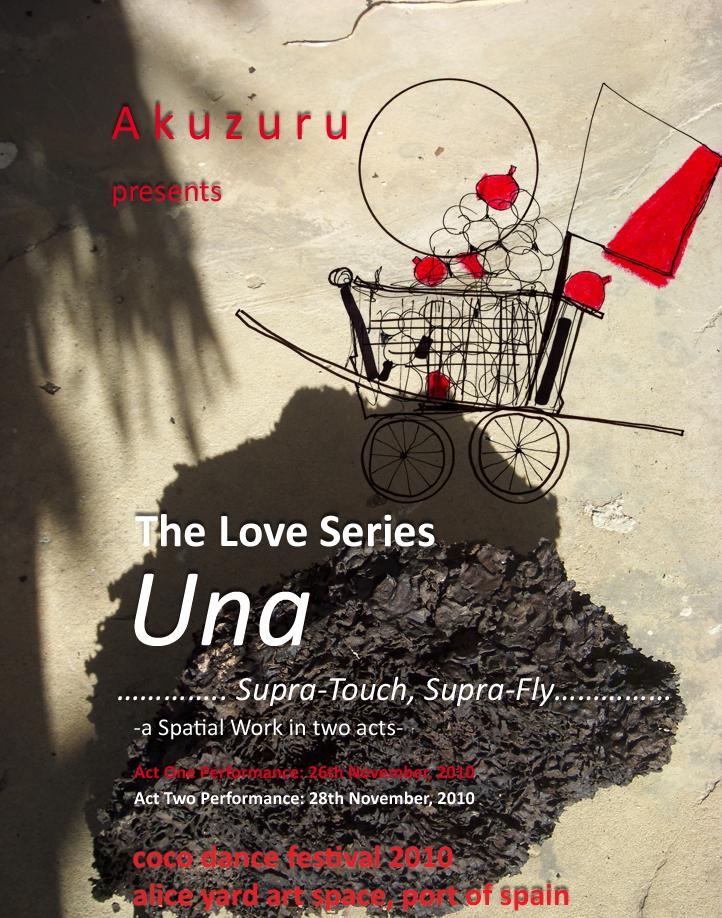
Akuzuru's Una at COCO dance fest
FROM THE ORGANISERS:
Act 1 RED: the prelude to the main performance on Sunday, will be in motion on Friday 26 November at 8.30pm from the Alice Yard Art Space on the street.
Act 2 WHITE: continuing as a much more extended presentation, will be in motion on Sunday 28 November. Starting at 5.45pm with a walking action from the General Hospital in Port of Spain, around the Queens Park Savannah route to Alice Yard, this performance will continue from Alice Yard at 7.30 pm on the street. The public is invited to ‘walk with me’ before viewing the main performance later on.
ABOUT:
A k u z u r u is an Experiential Artist who is known for her performance art and large sculptural-installation works. Born in Trinidad, her works have been shown internationally in the Caribbean, Europe, Africa and Asia. Interdisciplinary in approach, the artist creates intense experiences, working primarily in the natural environment in site specific situations. Just a few examples of where she has participated in and presented her works include the Nottinghill Carnival in London; LIFT:_London International Festival of Theatre; The London Samba Festival; the 2nd. Biennale de Martinique; Rockstone & Bootheel Exhibition in USA; Solo exhibition at the National Museum of Trinidad & Tobago; Solo exhibition at the Caribbean Contemporary Arts (CCA) and her epic journey Earthology India in India.
COCO Dance Festival ’10 presents the Moving Movement Museum at Alice Yard and Bohemia
The Contemporary Choreographers’ Collective - nicknamed COCO - is a group of independent choreographers - Dave Williams, Nicole Wesley, Nancy Herrera and Sonja Dumas – which offers performance support for choreographers working in unconventional ways in Trinidad and Tobago. COCO will host its second annual dance festival from Friday, November 26th to Sunday, November 28th – this time in a series of unusual spaces.
Showtimes are as follows: Friday, November 26th and Saturday, November 27th – 8:00pm; Sunday, November 28th – 7:00pm. Tickets are available from the choreographers and from the organizers. Kindly call 622-4426 to make reservations. Security will be provided.
11/19/10
New 'Green Lantern' trailer...yippie!
It's looking like a cross between Iron Man and... Iron Man. With Chris Evans (the flame from Fantastic Five...or Four?) There are concerns over the tired tones:
"There is a distinct whiff of Iron Man to the debut trailer for Green Lantern, which hit the web earlier this week. Cocky hero plunged unexpectedly into superherodom and required to shape up to new responsibilities? Check. Rousing hard rock soundtrack? Check. Attractive female discarded with wisecracking insouciance? Yes, Green Lantern even borrows an early scene from Jon Favreau's 2008 film---Guardian, UK.We await with trepidation!


