art in all its forms

art in all its forms

9/25/16

FILM REVIEW: Play the Devil

Gareth Jenkins and Petrice Jones


WHAT IS most taboo about Play the Devil is not its examination of gay life in Trinidad and Tobago. Rather, the work unsettles by throwing up questions about the power dynamics that exist when two persons of vastly different ages are in a relationship.

Of course in repressed, spiritual Trinidad and Tobago we talk about neither. We also ignore the grim implications of the vast inequalities of wealth nurtured and perpetuated by our rigidly-structured society.

The film follows Gregory (Petrice Jones), a disciplined, subdued and struggling 18-year old student who meets James (Gareth Jenkins), an older, wealthy businessman. James makes a move on Gregory who, in turn, encourages and accepts the older man’s advances. In one important scene, the younger man actively explores his sexuality with James.

The trope of doomed love between two persons of widely differing ages is a classic one in art. Consider Nabokov’s Lolita, Bronte’s Jane Eyre, Hardy’s Tess of the D’Urbervilles, and Eliot’s Middlemarch. In all of these male cougar stories, the love under examination is heterosexual. Here, the filmmakers flip the switch.

Other sources abound. Comparison with the 2014 musical theatre production Jab Molassie – which also starred Nickolai Salcedo (who appears in this film and is even more incredible on screen than he is on stage)—is inevitable. Like that tale, the story is set high above the capital in the hills, and a central character is seduced by a devil. But whereas the temptation in Jab Molassie was highly symbolic, in Maria Govan’s film the power of the erotic is not sublimated within the story. It is the movie’s central conflict.

Gregory’s inability to come to terms with his sexuality and James dogged campaign to take up residence in Gregory’s life breed disaster. While we must be weary of the trope of violence being used against gay characters in art, the resolution of the plot is, in this instance, not contrived and is in line with the demands of tragedy. The resolution is not gratuitous and also channels the grim reality of our violent society.

In the opening scenes, actor Gareth Jenkins leaves enough room for us to have different interpretations of James’s motives. Does he want just a hot date? Or is he looking for something more? From the perspective of Gregory – and also evidently some audience members at MovieTowne tonight – James might come across as predatory.

But the projection of negative motives on others is a hallmark of a life of isolation and in the closet. What Gregory actually fears is himself.

To some extent, James, for all his audacious provocations, is the true victim because his actions may well be motivated by a genuine yearning for love. Though clothed with greater wealth and power, James is as trapped as Gregory in a world where every aspect of his life has been brought under manners: his career, his family life, his attempt to act out his core being.

Therefore the roles of victim and villain are as interchangeable as the movie’s Carnival costumes. Gregory’s anguish at the film’s haunting climax is not just a reflection of the fact that all doors have closed on him, it is also the Edvard Munch Scream of all minorities relegated to life at the margins.

The subtle way the film handles questions of class, education and social power is among its strengths. Visually, this Abigail Hadeed-produced film is also sophisticated but not ostentatious. There is a memorable shot from cinematographer James Wall of Gregory literally shutting a closet, as well as one where he is split in the face of a mirror.

Govan’s script does a very good job of turning the screw, pitting Gregory against the forces of family, of religion, of gender norms for males in a macho society, of criminal violence, of peer pressure, of a scholarship-obsessed education system and of wealth disparities caused by a society concerned with money above all else.

Here, at last, is a film of great integrity for the age in which we Trinibagonians live.

The Strange Years of My Life


THE TITLE asks us to think of change. To look back, to reflect. To put into context past moments, past times.

This exercise of self-reflection is also one of estrangement. It places one outside of the parameters of what is being examined. It subjects a life to objective scrutiny, to reportage, a reporter's objective gaze.

But the reporter’s selection of facts is an inherently subjective exercise. And what is really strange? To whom? To which version of the self?

Is strange necessarily pejorative? The unusual, surprising, alien can be pleasurable. What has happened to change things, to render these years different or differently perceived?

And whose life? The poet's? Or a persona of the poet? Is there is difference?

Thus, the title of Nicholas Laughlin's book, The Strange Years of My Life, like the best titles, is already a poem. It suggests autobiography, but flags the conflict between truth and perception. This is an epistemological conundrum. When does the mirage end?

When we encounter books of poetry we seldom have the author at our disposal. The poet's processes are often not documented and are largely unknowable to the reader. When a poet speaks about the work, it is easy to dismiss this as the poet's own reading of what she has done; as just another reading among many possibilities. But it is still a worthy exercise to look at what Laughlin himself has said of his own work, decades in the making.

"The poems belong to a hemisphere of the imagination that encompasses the narratives of nineteenth-century travelers and twentieth-century anthropologists, spy movies, astronomical lore, the writings of Saint-John Perse and Henri Michaux, and the music of Erik Satie," the poet says. "They balance on the edge between concealment and revelation, between bemused fascination and tentative comprehension. Every sentence is a kind of translation, and language is a series of riddles with no solutions, subtly humorous at one turn, sinister at another, heartbroken at the next."

The Strange Years of My Life: manuscript notebook, successive typescript versions, proofs, book (Photo by/from Nicholas Laughlin's Flickr.)


The troupe of “friends” and “strangers” whom the reader encounters in these pages, he says, are sometimes alter egos, sometimes aliases, sometimes adversaries. They inhabit a milieu of mistaken identity and deliberate disguise, where “there are too many wrong countries” and “already no one remembers you at home.”

These statements are apt. However, because poetry moves us by holding up mirrors, I also find reflections of Trinidad and Tobago life in this work. The brief poem 'Ars Poetica' is billed as a treatise on art, but its reference to guns inevitably invokes ideas of crime and punishment in this bloody society. It further makes us question the place of art in this at times fetid state. Yet, though some have dismissed art as a thing of ornamentation, they forget its power, how many people exist today simply because of that one poem, that one movie, that one song that got them through a difficult time. If Laughlin's poem says anything, its conjunction between poetry and violence reflects how words can do things in today's world.

Last week, Trinidadian poet Vahni Capildeo was awarded the Forward Prize for her awesome book Measures of Expatriation. Her work has astonished and her seven published works comprise an achievement in their own right. It's a good time to reflect on the place of the poet in the Caribbean region as a whole. Both Capildeo and Laughlin’s poems are implicitly political. They liberate us from tendencies that would seek to box Caribbean writing into a narrow corner.

On another note, this shall be my final column. I'd like to thank readers for, well, reading. Maybe you agreed. Maybe you disagreed. Maybe you were moved. As I move on after ten brief years of journalism, I can’t help but look back and embrace the title of Laughlin’s book. Often we have dreams and don’t pursue them. But what if we give ourselves permission to do so? I’ve one word for all the years of doubts. Enough.


From Sunday Newsday, Sept 24, 2016
* * *

READ

Lagniappes 

From the archive

Anu Lakhan on The Strange Years of My Life 
at Annie Paul's Active Voice blog here


9/11/16

Alice Yard: X

Christopher Cozier, Nicholas Laughlin and Sean Leonard

A LOT can happen in ten years. Ask Christopher Cozier, Nicholas Laughlin and Sean Leonard. Ask the artists, the dancers, the mas men, the musicians, the poets, the writers, the academics, the curators, the publishers, the bloggers, the film-makers, the graphic designers, the projectionists, the lecturers, the audio technicians, the carpenters, the workmen, the civil society activists, the craftsmen, the curious strangers. 

This September, Alice Yard marks ten years and this evening it opened a year-long series of events by hosting a new installation by Blue Curry.

Blue Curry's Untitled (Alice Yard, assorted combs) 

"I am always a bit cautious when I encounter the work of Curry," says Cozier. "His work confounds and confronts, but with precise and strategic composure....I would not trust these objects - just so - no matter how visually appealing."

Indeed, what objects can we trust? Curry's work transforms banal things, isolates them from their functions, opens the mind to appreciation of their aesthetic qualities, and then puts them back together again into a new sculpture - a kind of dance without movement. In the process, he repurposes the viewer. One man's trash is another man's treasure. And one man is also another. These are found poems. 


Cozier tonight traced the origins of Alice Yard to a conversation during Galvanise.

"We thought it would be interesting to start that conversation again," he said. In coming weeks, several events are planned, including a collaboration between Cozier and Blue Curry that seeks to shift encounters with art into public spaces, dissolve the boundary between makers and viewers and reject the notion of art as commodity.

Kriston Chen's toofprints
On a personal note, I've been around Alice Yard for years and participated in two iterations of Douen Islands there. The space has never stopped being exciting. It's never stopped. The only thing that might have changed is the fact that these days, some have more greys.

'We began ten years ago with questions and possibilities. Our evolution has been organic and open-ended. As we consider our actions and ideas of the past decade, our instinct is less to celebrate and more to affirm our spirit of investigation and exchange, our ethos of generosity and independence.' 

Conceptual sketch of Alice Yard by Sean Leonard

6/1/16

From prison to poetry

US poets Rowan Ricardo Phillips and Dwayne Betts. Photo: Marlon James/Bocas Lit Fest


DWAYNE Betts has told the story before.

When he was just 16-years old, Betts was jailed for a gun crime. Inside, he found freedom from an unexpected source.

“I was in solitary confinement,” Betts recalls, speaking at the NGC Bocas Lit Fest on April 30. “You could call out for a book and someone would slide one to you. Frequently, you would not know who gave it to you. Somebody slid The Black Poets edited by Dudley Randall. In that book I read Robert Hayden for the first time, Sonia Sanchez, Lucille Clifton. I saw the poet as not just utilitarian but as serving art. In a poem you can give somebody a whole world. Before that, I had thought of being a writer, writing mostly essays and maybe, one day, a novel. But at that moment I decided to become a poet.”

The poet – who read at the festival alongside fellow American poet Rowan Ricardo Phillips – also conducted a poetry workshop at the Port-of-Spain Prison on April 29. The experience changed everything.

“The first thing that hit me was that there was just a bunch of people in jail on remand who had not had an opportunity to see a judge; to have a trial,” Betts tells the literary audience gathered at the Old Fire Station on Abercromby Street, a few blocks away from the penal facility at the heart of the capital. “I went into the jail and I was struggling to reconcile the profound injustice and the profound pain that happens, that permeates an entire community that does not get acknowledged at all.” In his workshop, prisoners were asked to write.

“The poems these guys wrote had this same pain and frustration,” Betts says. “In the US, most of the prisons are built way out where you can’t see. One of the things that also struck me is they are right here and still seemingly invisible.”

Betts, whose poetry chronicles some of his own experiences with the US justice system, says the workshop changed him.

“What does it mean for me to be in that space and talk to them? I hope that something I said made some sense,” Betts says. “You kind of forget what it means to have certain kinds of privilege, some kind of access to justice. If you come from the States and you are interested in criminal justice reform issues you get this very narrow view of what justice should look like and you take for granted that the system works extremely well– both to lock you up and to give you some semblance of opportunity for justice formally.” He adds,  “What I walk away with in terms of what they gave me is a challenge, both in terms of my writing and in my living.”

Betts is the author of the poetry books Bastards of the Reagan Era (described by the New York Times as “fierce, lyrical and unsparing”) and Shahid Reads His Own Palm, winner of the Beatrice Hawley Award. He is also the author of an excellent memoir, A Question of Freedom, which chronicles his experience of the US justice system. In prison, he was re-Christened Shahid.

“It means witness,” Betts says.

At the event – which was supported by the US Embassy – Betts read poetry alongside Phillips, author of acclaimed collections The Ground and Heaven, which was in April shortlisted for one of the world’s biggest poetry awards, Canada’s Griffin Poetry Prize. Heaven was named one of the best books of the year by The Washington Post.

“The role of the poet is to write good poetry, period,” Phillips says. “But if you do other things, you do other things. If the poet is a politician, be a good politician. If the poet is a parent, be a good parent. The poets of the future will decide what good poetry is.” For him, craft is key, particularly form and sound.

“You live by the syllable,” Phillips says. He warns against labelling. “We are always related to some kind of event that has already happened. I don’t want to be related to anything. I don’t have to think that I’m related to Dante or Langston Hughes. I’m not responding to Wallace Stevens. The role of the poet is to write good poetry and to find good poetry.” For him, understanding the world is a constant process of re-evaluation.

“I grew up in New York,” Phillips says. “Completely by accident I grew up in an Antiguan household. When they hear or read my name, people don’t know if I am male or female. People don’t know where I’m from. So in a way you are always translated. We are always constantly translating. The classical stuff has always been important, including myth. To me it’s how you understand the world through storytelling.”

- From Newsday, May 31st, 2016

5/21/16

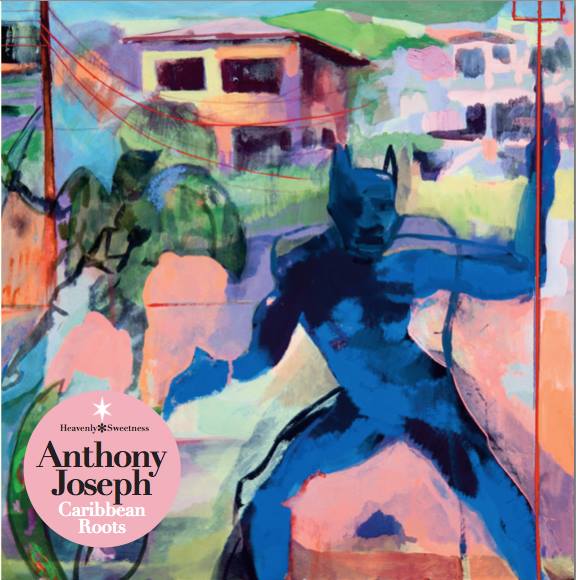
Poet Anthony Joseph traces his ‘Caribbean Roots’

The album's cover is by painter Che Lovelace, son of novelist Earl Lovelace.

By Andre Bagoo


THE TITLE track of Anthony Joseph’s latest album ends with a statement from Earl Lovelace.

“Our history is not colonialism and slavery,” Lovelace says. “Our history is our struggle against enslavement and colonialism.” This is central to the album and Joseph’s work generally.

Joseph is a Trinidadian/British poet, novelist, musician and lecturer resident in London. Not quite calypso, not quite soca, not quite rapso, not quite extempo, not quite blues, his latest album is, simply, poetry.

In Caribbean Roots, Joseph is evangelical. His spoken word sings. At times he is direct. Occasionally, the music seems unnecessary. But more often than not, it wraps itself around the words, reflecting the complex history which Joseph addresses. This work is a paean to the Caribbean.

“You realise that you rooted in the muck of history,” Joseph says in the title track. “And you begin to look around the majesty of old Europe and the citadels of its power, and its grand architecture set in old stone. And you begin to ask yourself where are my monuments? How come all these monuments – even the ones in the islands – were built by those who colonise and enslaved me?” He continues, “You need to set yourself in the soil / of these Caribbean roots”. The poet roams Europe, bringing news of the Antilles. From first to last, this work is an assertion of his identity, as complex as that may be.

The opening piece references Derek Walcott’s famous Nobel Lecture, ‘The Antilles: Fragments of Epic Memory’, with a kora becoming part of “a complex science of sound”. The personal and political mix, the poet voyages alongside the, “memory ghost of my father, memory ghost of my mother.”

The saxophones of Shabaka Hutchings (The Heliocentrics) and Jason Yarde, the trumpet of Yvon Guillard (Magma), the bass of Mike Clinton (Salif Keita), the trombone of Pierre Chabrèle (Creole Jazz Orchestra), meld seamlessly with the steel pans of Andy Narrell. Each track proceeds like the section of a Carnival band. David Rudder makes a guest appearance, tribute is paid to the Mighty Sparrow, there is homage to Lord Kitchener.

In 1993, Lovelace also said, “This world doesn’t belong to somebody else and it doesn’t belong to just me either. It belongs to me too. I say that sets the terms of my writing: I deal not particularly with a little group of people somewhere on the periphery of existence, but at the very center of existence.” So too, Anthony Joseph.

FOR MORE INFO see:
www.anthonyjoseph.co.uk


*
Newsday
May 21, 2016,

12/29/15

'My ambition was to become a writer'

Trinidadian-American poet Mervyn Taylor was last month honored for his contribution to education by the Trinidad & Tobago Alliance, at Brooklyn, New York. He shares with us his address on that occasion. 


Trinidadian poet Mervyn Taylor at the Bocas Lit Fest, Port-of-Spain, 2014

In high school I earned the nickname Teach. I came by it honestly, since I was always shushing the boys so I could hear what the teacher was saying. I would have preferred something more flashy, like Dancer, or Blade. But since I wasn’t bad, I settled for Teach, though once or twice I tried to throw it off, by doing something dangerous, or disrespectful. It just wasn’t in me.

My ambition was to become a writer, of stories, novels. In college, I turned to poetry. I was working at a publishing company, when a colleague from a writing workshop asked me if I wanted to teach. I said I’d never taught before. He said, of course you can. That’s how I got my first job in teaching, at Bronx Community College. And so it began. Since then, I’ve taught on every level, sometimes high school in the morning, college in the evening. High school is where I learned the most- about life, about people, about education, where I heard the truest excuses for not doing homework - my uncle and them was bagging weed in the room and I had to help them. Or, the whole building was in darkness because the inspector find the line we run from outside. Rough stuff. And it wasn’t like when Mr. Defour just cough in Belmont Intermediate and the whole class get quiet. I had to try tricks, like Hear nuh allyuh! And the accent would make them stop, and laugh, just long enough for me to distract them and bring them back to the lesson, to the line in the poem. Yeah, mon, is how they would mock me when they ketch theyself. I learned a lot from them, names like Jasper Lucky and Pazazz. African-American and Dominican and Puerto Rican and Jamaican and Guyanese and Trini all mix up, all trying to figure out what they doing here. Today I see them on Facebook, proud of how a daughter is learning to read, shocked at the behavior of those 'knuckleheads' on the train. Sometimes I remind them.

One of the best rewards for my years of teaching came when a good friend introduced me to his younger brother, who said that after seeing me at BCC, and learning that I was from the same Trinidad he was from, he decided that if I could be a teacher, he could be one too. He has just retired from a career of thirty years. He comes to my poetry readings all the time.

What’s in a name, you never know. It could bring you face to face with yourself. Hey, Teach! Whappenin dey, boy?

Mervyn Taylor
11/22/15


4/19/15

A biographer in search of his father

Arnold Rampersad’s ties to mysterious ‘McGee’ column of 1940s

By Andre Bagoo


Arnold Rampersad
IN THE opening chapter of his biography of the great poet Langston Hughes, Arnold Rampersad notes Hughes once said, “children should be born without parents– if born they must be.” Rampersad – the acclaimed Trinidadian biographer – writes extensively about figures such as Hughes, Ralph Ellison and Jackie Robinson. Yet, arguably, a book is waiting to be written about Rampersad himself and his relationship with his father, one Jerome Ewart Rampersad.

“He was a scamp,” Arnold, the son, said last week Thursday as he delivered a lecture on Jerome. “Which is what John Babb called my father recently, although I intervened to say I thought he was more a thug than a scamp. He never allowed us to call him Jerome though he allowed other children he had later to call him daddy and so on.”

The event was a lecture organised by the group known as the Friends of Mr Biswas on the newspaper column, “Mc Gee”, to which Jerome has been tied. As Arnold made clear to the audience gathered at the AV Room of the NALIS on Abercromby Street, Port-of-Spain, the Mc Gee column of the 1940s was very popular. At one stage it was said to have single-handedly sold the Evening News, the tabloid put out by the Trinidad Publishing Company. References to McGee appeared in calypsos at the time, including one by Lord Invader called “McGee”. Figures like Karl Hudson-Phillips appeared in it. Invader sang, “I’m trying to live peacefully because I don’t want McGee write about me.” The column and the newspaper were read at the sidelines of football matches.

“It was certainly widely-admired among certain segments of the population,” Arnold, who was awarded the National Humanities Medal by US president Barack Obama for a lifetime of work,  said. “He would spin the stories in a particular style and people would find it on the whole a pleasure to read. I remember I read it with pleasure at a time when not every thing about my father pleased. (It) lead Trinidad journalism in a small but significant way to a fresh direction.”

But though wildly successful, the authorship of the column remains a mystery. In addition to Jerome, a series of persons have been tied to it including: Patrick Chokolingo; Lennox Raphael; Vernon Khelawan; Ewart Rouse; John Grimes; “a fella from down south, maybe his name was Alleyne”; and even, according to John Babb, “an unnamed young woman”.

The mystery of the authorship of McGee befits the mystery of the man Jerome Rampersad. He was born in 1917, as Geronimo Ewart Hernandez. His mother was Romana Hernandez, a woman of Venezuelan descent. It is surmised that his father was Christopher Rampersad, a “full-blooded Indian”, Presbyterian, school-teacher with “a multitude of descendants” (apparently including Junior Sammy).

“We know only a few facts of Jerome’s past, although there are people in this room who know more than I do, as usual,” Arnold said. Disappointingly, the name Geronimo was not in honor of the Apache hero, but rather Saint Jerome (Spanish-speaking Romana was a devout Roman Catholic).

In 1930, Jerome started work at the Port-of-Spain Gazette (later famous for the Ambard case) where he met Evelyn De Souza who had migrated from British Guyana.

“One day he left his job on the Gazette, got married and went back to the Gazette to finish his day’s work,” Arnold said. “There is much more I could tell you but I draw a curtain right there. In any event, the marriage was doomed after the birth of three children. Doomed and finished even before I, the third one, was born late in 1941.”

By 1945, Jerome had left the Gazette and had started at the Evening News, following the trail blazed by Seepersad Naipaul, father of VS Naipaul, to the Trinidad Publishing Company. Jerome developed a reputation as a trouble-maker and at one stage tried to organise a formal trade union for journalists.

For Arnold, the column played a role in shaping West Indian literature, even if indirectly. He linked its American, Damon Runyon-esque tone to, for example, VS Naipaul’s Miguel Street. It is likely that several persons wrote the column and that its tone, even if in homage to Runyon, tapped into a bigger cultural ferment which embraced the wave of Hollywood movies at the time, like those starring Bogart.

Whatever the case, the biographer argued McGee came at an incredible time. Said Arnold, “The 1940s represented the most volatile and transformative period of social change in the history of the island. The decade following World War II was, not coincidentally, characterised by social conflict of every kind. There was joblessness, illegal immigration, acute housing shortages, food rationing, racial friction, religious intolerance, erosion of moral and intellectual values. A new, exciting, challenging, puzzling and dangerous place. This was the precise, or maddeningly imprecise and volatile background against which Jerome Rampersad, allowed to do so by the Evening News, began to walk down the dimly-lit road to becoming McGee.”

The writer further stated, “As for my father, I have no recollection of him ever reading a book. But he must have read some. I know that I am going to offend people here. I don’t set out to be offensive. I’m just a biographer. Biography is having a jooking board and wash-tub set up in Woodford Square and you get the dirty linen washed away. Other kinds of biography is more like dry cleaning. There is no intermediate process that marks life.”

Jerome finished a short novel in 1962 that has never been published. He also introduced structural elements of writing fiction into his court reportage. He died, as Arnold discovered only last week, in 1978. Upon his death, the Evening News claimed his “last column” appeared inside the paper.

“He was close to destitution at that point and maybe the folks down at the Evening News took pity on him and allowed him to write,” Rampersad said. “But maybe not. I have no personal or family investment in this project whatsoever. This is not intended as a tribute to my father. Not interested. What’s left is the important part, understanding what was achieved.”

But if, as VS Naipaul once observed, the greatest way a writer can honor a person is by presenting them as they are, Arnold Rampersad may have, despite his protestations, already begun the process of paying tribute to his father and mysterious McGee.


-
from Sunday Newsday
April 19, 2015, p. 18

3/17/15

BURN - film poem no. 2


Second film poem from BURN by Andre Bagoo (Shearsman Books, 2015:http://bit.ly/1xvaYw0). 
See the first here: http://youtu.be/EnEEqNgCueo

2/19/15

BURN, a film poem


Film poem for BURN by Andre Bagoo (Shearsman Books, 2015).

AUDEN IN ICELAND

A sheet of paper crumpling on
Vodka, crevices draining into place,
Slopes of mountains torn agape.
I am in love with his face.

Desiccated cracks, diurnal longings -
Hewn, and by blades, eye a valley;
Skaters make grids of icy sweat.
This limestone, I will marry.

1/27/15

Favorite bedside books of 2014


YEAR'S END means its a good time to recap what you read and what you want to read in the coming year. When recently asked by writer Brandon Mc Ivor and his sister Breanne - who conduct writing workshops at Diego Martin - what were my favorite books of 2014, I realised that I had spent a lot of time catching up on books I've been meaning to read for a while. Many of them were poetry. Most written before I was born. And the vast majority were non-fiction. Instead of drawing up a list of my favorite books published in 2014 I've drawn up a list of books I read in 2014. (Or at least started to read!)

1. The Poetry of Derek Walcott 1948 - 2013, selected by Glyn Maxwell

Not the kind of book you read from cover to cover, though, of course, you could. Walcott's poetry endures because of his ability to find the essential elements of life and present them, in elegant, painterly strokes, in poems which achieve what he once said the best poems should. They are perfection's sweat but "seem as fresh as the raindrops on a statue's brow". I like how expansive this edition is and how you can still discover a Walcott poem you were not familiar with. At the moment, the poem 'Midsummer, Tobago' - from Sea Grapes - is my personal favorite. But that's like saying I like just one movie by Woodie Allen or one soca by Machel. Also up there for me is the opening poem of White Egrets and a poem called 'To Norline', from The Arkansas Testament.

2. Collected Poems, by W.H. Auden, edited by Edward Mendelson, along with The Dyer's Hand, by W.H. Auden

This was the year my family got fed up of the calls from NALIS saying I had a book overdue and decided to just get Auden's whole oeuvre for me. Nothing beats having this handsome edition of all of Auden's poems in one neat, compact door-stopping tome. Auden was a poet concerned with form. He also took on, like Dylan Thomas, an evangelical tone. Because of this, the achievement of some of his more daring poems - such as 'The Sea and the Mirror' - is sometimes overlooked. This is the poet who, in the poem, 'In Memory of WB Yeats', wrote the line, "The mercury sank in the mouth of the dying day". His Collected is uneven, but that will always be the case for any poet. Auden was also notorious for revising earlier published versions of the poems. You are guaranteed, though, to be surprised by something new, whether in a familiar poem or a poem you've not read before. The essays in The Dyer's Hand reveal Auden's wit, wisdom as well as the fact that he was an excellent writer of prose.

3. Capitalism and Slavery, by Eric Williams

The politician, man and historian may have been controversial - he is hated and revered in almost equal measure -but one thing is incontrovertible: this is a great book. Not only was Williams an excellent orator, but he could write. That's a pure and simple truth. And he could make a good argument, whether or not we agree with its finer points. The book remains relevant in a world where the projects of emancipation and independence remain ongoing concerns.

4. Discourse on Colonialism, by Aime Cesaire 

This should be mandatory reading for anyone concerned with the state of so-called post-colonial society. This book is not just a historical artifact of the kind of revolutionary spirit that was key to provoking ideas of change, but it contains insights about the process of colonisation that are relevant today in terms of still-lingering effects.

5. The Black Jacobins, by C.L.R. James 

If Eric Williams was a genius then I don't know what to call C.L.R. James, whose enormous body of work challenges, provokes and demands close, careful attention. This book is a tour de force. Consider, alone, its first sentence: "Christopher Coloumbus landed first in the New World at the island of San Salvador, and after praising God enquired urgently for gold." This is the definitive account of the Haitian Revolution, which contains important ideas from a writer who influenced major thinkers like Williams and Edward Said, among others.

6. The Waving Gallery, by Mervyn Taylor

More poetry. In a review of this book published in Newsday I wrote: "Every country is the undiscovered country. In this respect, there are no foreign lands. We are always constantly learning and discovering aspects of each place – home or abroad – as we are constantly discovering life itself. These poems are often sophisticated exercises that find an easy tone....Taylor gives us no answers.... He seeks to teach us the value of the truly examined life, to re-route the trip somewhat: to make it a voyage into the interior. He knows how fast a life fades, as quickly and abruptly as the day ends in the opening poem 'Mt Hololo'."

7. A View from the Bridge, by Arthur Miller 

Reading a play is an interesting experience. The words are not meant to be read but staged. The work is also meant to comprise action and sound, the stage is supposed to be a realm of light and shade. A reader must imagine all of these and flesh out details. In this sense, a play shares some of the qualities of a novel. But it also has the advantage of distilling the action to dialogue: it depends entirely on characters.

Arthur Miller is known for his most famous work Death of a Salesman, but A View from the Bridge is also a great play to read. It intimates a deep, buried secret. But when the dust settles we feel nothing has been revealed, even though everything has been made crystal clear.

8. Ma Rainey’s Black Bottom, by August Wilson 

In a Chicago-based recording studio, Ma Rainey’s band players, Cutler, Toledo, Slow Drag, and Levee turn up to record a new album of her songs. As they wait for her to arrive, tensions simmer — particularly around a young trumpeter appropriately named Levee — who has dreams of having his own band, and older players Cutler and Toledo. This 1982 work was one of Wilson’s cycle of plays which aimed at depicting the Black American experience over time. It stands as a record of race issues. But it is also a fascinating study of gender, attitudes to power, as well as band dynamics.

9. Utter, by Vahni Capildeo 

Full disclosure: I’ve collaborated with Vahni in the past and can be regarded as completely biased. That said, the strengths of this book are likely to be recognisable to lovers of poetry everywhere. This is a beguiling collection that races through ideas, moments and experiences with a verve and style which is completely Capildeo’s. It is sometimes difficult, intense. It is always lyrical, beautiful, mesmerising. The poems cry to be read aloud, slowly, with careful attention to the nuances of intonation. Utter pleasure.

10. Sounding Ground, by Vladimir Lucien 

Lucien’s voice is assured and strong, blending the personal with the political. These poems veer between rally cries and wry narratives. They are always moving. Personal favourites include, “The Last Sign of the Cross”, “Mi Jean”, “To Celebrate St Lucian Culture They Put on Display”; and “Tjenbwa: Ethnography”. The influence of Walcott is felt, but Lucien has found his own voice and concerns, some of which are often personal and, thereby, universal. This was an outstanding read.

11. Diatomhero: Religious Poems, by Lisa A Flowers 

Despite the title, these are not evangelical poems. Or if they are, the message they seek to preach concerns the fluidity of our perceptions and senses: how life’s margins might be more permeable than we imagine. There are long sequences which I could not stop reading, due in large measure to Flower’s talent for unforgettable imagery. Additionally, the poems allude to fairy tales, novels and myths. They intoxicate and evoke complex feelings. “I was already in paradise”, Flowers writes, “Waiting out my death”.

12. Voyages, by Wayne Brown 

In a recent column, of this book I wrote, “Voyages is a tour-de-force. Poems include “Monos”, “Drought”, “Crab”, “The Approach”, “Mackerel” and “Whales”. The sea is a key theme, and it becomes a burnished forum in which life, joy and death mingle. In ‘Poem Without End’, Brown states, ‘I write with the night in my veins.’ Like his deep, smooth voice, his best poems glimmer in the dark, they express ideas and images in hewn dreamscapes.”

As I continued to review books from the poetry scene, I also read: The Dustbowl by Jim Goar; Performance Anxiety by Jane King; Subversive Sonnets by Pamela Mordecai; Fault Lines by Kendell Hippolyte; The Butterfly Hotel by Roger Robinson and Difficult Fruit by Lauren K Alleyne. I also dipped into tomes by Dylan Thomas and the poetry of Ian McDonald.

But 2014 is over, and we are in a new year. Already, the first book I’ve cracked open is Days of Wrath by the journalist and poet Raoul Pantin who died last week. This is an intriguing read which is itself an important artifact of the events of 1990. I’m looking forward to reading more. So many books, so little time!

*

Sunday Newsday, January 11, 18

11/18/14

The politics of Jab Molassie

Roger Roberts as Jab Molassie


IN AN INTERVIEW in 1978, Trinidadian novelist Samuel Selvon set out a conflict he faced in his work. For him, there was a tension between the use of standard English and the everyday language of conversations, the vernacular.

"I still have this problem of having to think consciously of what I am going to say and how to phrase what I want to express," Selvon said. "I grew up in Trinidad speaking the way Trinidadians talk. And that remained with me throughout all my years living abroad. I find that if you were a Trinidadian and I was talking to you, perhaps I could slip into the dialect form." He felt strongly that dialect is to be presented in standard English, not written phonetically.

"I feel this jars on the readers' eyes and it makes any dialect form so much more difficult to understand," Selvon said. He was not the only writer to have this view. Other novelists have taken a similar stance, such as Merle Hodge in "Crick Crack, Monkey".

The tensions set out by Selvon are reflected in "Jab Molassie", a work of opera which seeks to immerse its audience in a Trinidadian scenario using language which, though poetic, remains in dialect, with the added complication of being in rhyming couplets.

"Jab Molassie" follows Starboy as he gives up something precious to him for the sake of material gain. It is a story set in Laventille written by an American, Caitlyn Kamminga, who grew up in New Orleans and moved here from her last posts at Hong Kong and the United Kingdom.

Kamminga has clearly bent over backwards to replicate authentic Trini dialect. At the same time, she has kept the language in formal rhyming couplets. This is an unusual blend which some audience members took a while to adjust too. Others, though had no problems. I felt what was being communicated was clear enough. However, some restraint would have been beneficial. In everyday language, Trinidadians slip in and out of standard English. Therefore, the approach to the dialogue should be more multi-faceted. The text gains if it does not stick pedantically to the vernacular at each and every line. This is the balance which Selvon thought he found in his novel, "The Lonely Londoners".

That said, the tensions in the language of "Jab Molassie" did not overly harm my experience of it. Perhaps this was because the medium of opera comes with an expectation that things are not going to be natural. Persons entering an opera - when they do actually enter to consider the art - do so with certain expectations, bracing for a peculiar experience. Opera is difficult. In the first place, most are in foreign languages. Also, they can sometimes seem highly-mannered, stilted. As lush and beautiful as some productions are, modern audiences can feel alienated by the formality of the language used. Yet, this same formality is what draws others.

The tension of the language of "Jab Molassie" does not detract from the work because we are already within a heavily stylised realm. In a weird way, the unrealistic nature of the dialogue enriches the sense of another world being created and the ideas raised within it. The language mimics the political themes within the story. For the use of our dialect is not just an attempt at realism. It becomes an assertion of identity. It demands the audience come to grips with it. It shows that it has a place in the high art of opera. As imperfect as it is formulated, the language paints a vivid picture of who we are.

What "Jab Molassie" represents is never expressed. We understand it is about material gain. But we are left to project other possibilities such as: party politics; crime, violence and gangsterism; power; gender; self-representation; nationalism versus individualism; addiction, drugs and booze; love or all of the above. There is a strong social sub-text. The production is about the different things that lure young people. The common thread is temptation. The Jab is the devil himself.


At one stage, Starboy trades his precious violin for a magic book which gives him whatever he wants. But it is suggested this comes at a price. It is notable that a book is the taboo object which seduces and turns Starboy to possible oblivion. Is this a critique of knowledge? Of book-sense as opposed to commonsense?

An interesting aspect of "Jab Molassie" is the decision taken to have both female and male embodiments of characters. So the narrator, the Corporal, is split into two roles played by a female and male actor. So too the titular Jab. Also, at the run at the Little Carib Theatre, Woodbrook, from November 6 to November 9, the orchestra was placed onstage. While there are space constraints at Little Carib, I wonder how things might have worked with the orchestra amid the audience?

Though this show is entitled "Jab Molassie", it's all about Starboy and his coming of age. We are absorbed by this. However, I felt the production was too short. I wanted to know more about Starboy and understand the context within which he operated. While there are merits to a short, breezy production, the fallout is the development of conflict. We do not really see the price Starboy pays for his decision and thereby must project our own ideas of the worth of his salvation at the climax.

The strongest aspect of the production is its music which cannot be faulted. Dominque Le Gendre's score is incredible. Her contribution to Caribbean culture I fear is not properly understood. Her work is powerfully stamped by her unique aesthetic. Ironically that aesthetic is a cosmopolitan, Caribbean one, which has been described as creole, meaning it is hard to pin down. The tonal qualities of her music, the precarious balance between play, darkness and ambiguous lyricism, her unabashed passion for vintage Caribbean melody and form and for infusing these elements within an avant garde sensibility make for true magic. Because of the music and the skill of the actors, "Jab Molassie" achieves the sublime. It mesmerises with its sections about love, then grips you in terror.

The production design was also beautiful, with stock light projections chosen by Benny Gomes and director Patricia Cumper suggesting the hills of Laventille in a manner reminiscent of Braque.

The performance at the Little Carib Theatre made me wonder where Nickolai Salcedo has been before all this. Yes, a bandleader, yes a painter. But here he is intriguing, mercurial. You wonder what is next. Roger Roberts, of 3canal fame, and soprano Natalia Dopwell were perfectly cast as Jab Molassie, embodying menace. That said, I sometimes wished both characters had more shades of complexity.
The narrating Corporal was a highlight, played by Wendell Manwarren and Germaine Wilson. Of Starboy, the Corporal remarks: "That boy clever, but he ain't smart!" and, later, "He got everything, /Tout Bagai! / Everything he want / The book provides. / But he startin' to feel / Empty inside." Overall, this production, an adaptation of Stravinsky's "A Soldier's Tale", was better than the original.


*

- from Newsday, November 18, 2014

10/20/14

‘I fell in love with Trinidad’


ONE DAY, it all clicked. Miquel Galofré was at his grandmother’s house at Sabadell, a small city 30-minutes from Barcelona, Spain. He was listening to the Rolling Stones’ “Still Life”. He was 12-years old.

“I was a neglected child, my parents were too young and they had problems,” he says. “I had to handle a lot when I wasn’t ready for it. So the world was not a nice place for me at that time. I cried a lot in my bed.”

“But things got better when, as a teenager I discovered music and films. The click was a Rolling Stones cassette when I was 12. And now I use all the feelings I have experienced in my life, in film,” the film director and editor says.

Galofré’s description of his own childhood evokes scenes from his most recent film, “Art Connect”. That film, which features children coming to terms with their problems through music, dance and painting, was awarded Best Trinidad and Tobago Feature Film at the Trinidad and Tobago Film Festival (TTFF) in September. It also took home the People’s Choice Award for Best Documentary Film.

“With ‘Art Connect’ I basically wanted to do two things,” Galofré says. “I wanted to help a group of teenagers from Laventille to be happier. And I wanted to show in a film that this kind of program does work and they should be done in every school.”

Like the titles of his other films (“Why Do Jamaicans Run So Fast?”, “Hit Me With Music”, and “Songs of Redemption”) suggest, Galofré is a filmmaker interested in music and the uplifting potential of film. Whether set in a Jamaican prison or the Success Laventille Secondary School, he tells deftly-edited, immaculately-paced stories that weave several elements but ultimately  – no matter how dark the subject-matter – end up blossoming into lyrical outpourings of love.

“A film should hit you and give you energy!” the director says. “You should come out the cinema feeling able to do anything, with a smile in your face and in a rush to make your dreams come true. Like a good song, it should make you stand up and move, with a big smile.”

***

Miquel Galofré was born on June 1, 1970.

“I was conceived in Ibiza, the small, beautiful Spanish island known for crazy parties and drugs,” he says. “And I was born nine months later in Barcelona, Spain.” He is reluctant to talk in detail about his parents, but says, “I didn’t grow up with them and I was a very sad child, feeling guilty for all the dramas, fights, abuse and alcoholism that were around me.”


Galofré, 44, traces his passion for art, generally, to that moment when he was 12 at his grandmother's house listening to "Still Life".

"When the riff of the guitar of the first song ("Under My Thumb") started, my life changed for ever," he says. "That energy woke up everything in me! I got goosebumps, tears welled in my eyes. I had a burning need to jump and a strong wish to live!" He also recalls the impact of a favorite toy.

“My grandpa had some Super-8 cameras and that was my favourite toy ever,” he says. “Unlike other kids, I didn’t enjoy cartoons, fantasy, or kid’s games but I always loved to look at the world through the lens. To this day, I think I use cameras as a tool to find beauty in the world. And I started very young. At 12, I started editing with Betamax videotapes and I never stopped.”

By the time he was eighteen, he was seeking work and found the job that cemented his passion.
“I saw an ad on TV,” Galofré says. “They were asking for home videos for a contest. I sent more than 100 and they called me, not to participate in the contest, but to work with them in the TV company. Working on TV I learned a lot. I was there more than 20 years doing all kinds of stuff.” One of his tasks was to film and edit the castings/auditions of people trying to get into the Spanish versions of American Idol or Big Brother.

“The videos were very successful and people always told me that I made them get emotional and cry,” Galofré recalls. Eventually, he decided to study film. But the experience in television was teaching him things faster.

“There is no better school than that,” he says. Television took him all over the world. By his count, he’s been to 26 countries. Then, in 2010, he came to Trinidad.

***

"I would say I came to Trinidad following my dream of making films and also trying to know who I am," Galofré says. His first time in Trinidad was to attend screenings of one of his films, "Why Do Jamaicans Run So Fast?", at the TTFF. The film had screened previously at studiofilmclub (run by painters Peter Doig and Che Lovelace) and was well-received.

"I came for a week and I fell in love with Trinidad," Galofré says. "Trinidad has something that makes me feel at home, it's such a unique place. It took a while to understand it and it has not been always easy at all."

The filmmaker continues, "I meet a cool guy called Alex Smailes, a photographer who is today my friend, who asked me if I wanted to make a documentary in Trinidad with him. I said yes. And after 6 months I was living here ready to film." Though a trailer was produced for "Mike Men of Trinidad" (you can find it on YouTube), the film has to date not been completed due to a lack of funding. But Galofré remains undaunted.

"I feel I still have some important stuff to film here," he says. "I have my company here, called Trinidad and Tobago Rocks! (which has a Facebook page, search for "TandTrocks").

Despite the ups and downs, the affair has lasted unusually long by Galofré's standards.

"I have traveled a lot, filming in more than 26 countries but I've never stayed for more than 2 months abroad, I always came back home to edit," he says. "But the same feeling I had when the plane landed in Barcelona I have it every time the plane land in Piarco.  Home." But he adds, "Then the immigration officers usually remind me that I'm not home!"

Galofré says he has two film projects due next: one a documentary and the other a narrative feature film, both in Trinidad. The documentary is based in the book “Wishing for Wings” by Debbie Jacob.

"What she does is amazing," he says of the book. "Instead of complaining about how bad crime is, she seeks to understanding why a kid becomes a criminal. I want to do the film about this to reach more people, people who don’t read books. Films are the new books. A country needs good books, good music, good art and good films. They write the history." Of the local film industry, Galofré says more needs to be done.

"It’s so young but the potential is huge," he says. "It has to happen. Trinidad is such a unique place: the mix, the contrast, the culture, social, political, cultural. There is so much stuff. Something has to be done and it’s urgent. The success of the TTFF shows there is space for other kinds of movies in Trinidad. To be honest, if nothing changes, I’m about to give up with filming here." To film students, or anyone thinking of becoming a filmmaker, Galofré does not mince words.

"The reality is that it’s very difficult to work in film," he says. "Make sure it’s your passion. Make sure you love it bad, bad, bad. You will have to put in a lot of effort. And ultimately, what is needed to become a filmmaker is not taught in any school in the world. Only life and a lot of work can give you the skills. You have to learn who you are, what you have to say, how to build a story, how to handle a crew, how keep people’s interest, how to touch them. But all is possible."

***


Miquel Galofré’s favorite films

“The Bicycle Thief” (1948, Vittorio De Sica), “8½” (1963, Federico Fellini), “Taxi Driver” (1976, Martin Scorsese), “Buffalo ‘66” (1998, Vincent Gallo), “Old Boy” (2003, Park Chan-wook), “Pulp Fiction” (1994, Quentin Tarantino), “In the Mood for Love” (2000, Kar Wai Wong), “Funny Games” (1997, Michael Haneke), “Head-On” (2004, Fatih Akin), “3-Iron” (2004, Kim Ki-duk), “Uzak” (2002, Nuri Bilge Ceylan), “Short Cuts” (1993, Robert Altman), “Tarnation” (2003, Jonathan Caouette), “Hedwig and the Angry Inch” (2001, John Cameron Mitchell), “Night on Earth” (1991, Jim Jarmusch), “Me and You and Everyone We Know” (2005, Amanda July), “E.T. the Extra-Terrestrial” (1982, Steven Spielberg), “The Shining” (1980, Stanley Kubrick).

***

-from Newsday, October 20, 2014.


10/13/14

The mirror has two faces


THE MIRROR has an ornate, gold frame. It stands onstage, as if floating, suspended solely by the movements of the dancer. He props it up, lifts it, hides behind it, and at one point is almost guillotined by it. The audience is made privy to a series of private moments: we all gaze at a person in front of a mirror, obsessed with self or with something refracted in its hard surface. He dabs white powder all over his face continually and, seeking perfection, tests his image anew in the face of his true, glass lover.

This is Dave Williams’ incredible, monstrous work of choreography, entitled ‘Older’, which was shown at the Coco Dance Festival on October 4 and October 5 at Queen’s Hall, St Ann’s. We may argue that the piece is about the relationship between self and self-image over time; a rendering of Narcissus. Or it may be about relationships with others, how they always reflect something about ourselves. Perhaps as we get older we get wiser. Or equally we stay the same, make the same mistakes, play the same tricks of self-delusion and, well, it all just gets old.

The greatness of this piece is how it achieves what the best choreography does. It uses simple tools to create complex, dynamic effects. For instance, throughout the performance the audience is at times able to glimpse into the mirror and see what is being reflected. We see the dancer, in garish black spectacles that look like aviation goggles. Sometimes, in the dark of Queen’s Hall, we see only blackness: the type of deep blackness only a mirror can provide. But then, when the mirror moves, there is blinding light. Williams plays with its reflection, throwing it like a scrutinising beam all over the audience and elsewhere.

The effect is thrilling. We think of the powder on teenagers’ chests; Mr Sandman; Carnival sailors shouting: yuh can’t play mas if yuh fraid powder. We understand the vocabulary of this piece and we are compelled to follow to the bitter end when Jhené Aiko’s pop single ‘The Worst’ fades and we then hear a poem speaking of the nature of aging, how it turns bodies that once seduced into transparencies. We understand, at this point, the absurdity of all of Narcissus’ machinations with his mirror, coming as they do in the face of the inevitable fade-out of death. The dancer ends his piece with the mirror on the floor, prostrate after being licked. He walks back into the darkness.

Williams has, over the years, cemented his position as a necromancer. His best pieces – like “Waiting” and “Roasted Swan” – derive their power, in part, from their physical challenge. Here, the challenge was how to sustain the relationship between the body and the mirror in an interesting and intelligent way.

Williams makes it look so effortless. He’s not only older, he is certainly wiser. We are left wanting more and, notwithstanding its achievement, I wonder if this piece is complete. But finished or not, its images stay in our minds.

In an interview with Newsday Williams said he was inspired by fragments of questions surrounding the process of aging, mindful that the careers of most dancers in times past were limited by age.

“It’s a short life span,” Williams says. “Ballet dancers are lucky if they make it to 35.”

The dancer continues, “I wanted to do something that I was interested in.

“Because I have been dancing for 29 years and aging, I’ve noted how the body raises pretty immediate questions and situations. Aging was something that I was interested in. Nobody tells you what to expect. When I was child, 50 was an old person. The idea of aging gracefully, what does that mean in the current era?” He states ‘Older’ is an excerpt from a longer piece which will be shown on November 17 and November 18 at another show at Queen’s Hall, put on by the Noble Douglas Dance Company.

Other highlights at the Coco festival included Sonja Dumas’ ‘Walk the Talk’, an intelligent and beautifully structured take on stereotypes and how people – particularly women – are judged by how they walk. A similar feminist cord was found in ‘Farm Girls’, Sharifa Hodge’s piece which sees the limiting tropes applied to women in calypso and soca re-appropriated by the women onstage in a way that overcomes. ‘Hidden Curriculum’ by Deliece Knights had a similar intent, though wider scope, with intervals that voice specific thematic concerns about gender, power and discrimination in society. These threads were also woven into Akazuru’s ‘The Elemental \I. Hail for Stones’, which saw a procession and protest outside of Queen’s Hall, with rope being tied to the building’s pillars. ‘NeoIndigenA’ was a raw and audacious piece which was incredibly effective, provoking thought about the indigenous populations and their fate. ‘Beyond Words’ was a promising video. All of it was part of a programme which featured many other gems which shined in the dark.

*

- from Newsday October 13, 2014

9/21/14

Only connect

Art Connect

SINCE, as one student featured in the documentary Art Connect states, art is a picture of life, this film stands on its own as a sublime work.

Ostensibly about a social intervention programme for a group of students in Laventille, the work turns out to be an acute observation of contemporary social conditions in Trinidad and Tobago. It's insights are sometimes subtle and understated: telling of absent parents, emotional violence, the impact of drugs and crime on communities, mental and emotional turmoil, communal prejudices. But also, refreshingly, it sings of the redemptive possibilities of love, trust and beauty. Though there is tension and danger, all hope is not lost.

We follow the group of students of the Success Laventille School as they participate in a series of projects and challenges marshaled by artists in different mediums. But we also hear them tell their own stories about their lives, through a series of unforgettable interviews conducted by the filmmakers (including Janine Fung). And, most memorably, we are gifted with footage filmed by the students themselves using point-of-view cameras. We learn of their conditions, hear of their family problems, see where they live and what they eat, what chores they do, whom they interact with and account to.

"What's one of the happiest days of your life?" a student is asked.

"I don't have one," the child answers.

"What about a happy moment?"

"One of the happy moments was when I found out I got into this programme but I don't really have happy moments," states the girl. At another stage the girl says, "I actually feel nervous when I hear... gunshots because I don't know if my brother picked up one or my dad."

Another student states, "I feel that I cannot talk and I don't know why."

Sadly, these students could be in any school anywhere in the country. They articulate universal anxieties, as well as peculiar problems which communities are today dealing with. The film, which premiered in the first week of the Trinidad and Tobago Film Festival, gives voice to open secrets, and in this way, does a kind of justice, asserting dignity and grace. It has deservedly attracted sold-out screenings. Trinidadians have been yearning to see themselves.

This is an assured documentary whose craft is concealed but whose achievement cannot be overstated. Here are several different narratives which unfold through the use of the point of view footage; the interviews; pop music; supplemental footage and the mediums of song, dance and painting. That all these elements fuse effortlessly is to the credit of director and editor Miquel Galofré, who has steadily cemented his status as an exciting and talented chronicler of this region through a series of bravura films.

Galofré is a multiple-award-winning filmmaker born in Barcelona and based in Trinidad and Tobago. His “Jamaican trilogy” of documentaries - including Why Do Jamaicans Run So Fast? and Hit Me With Music - won several prizes. His eye for pacing, his exquisite judgment on the use of music as well as the restraint of his cinematographer (Fung) means this does not feel like a gimmick, nor does it come across as a sterile social experiment. Instead, it feels real.

On the music, I found that the film provided an interesting glimpse of how popular music - foreign and local - functions in our lives. Through music, and art generally, we do ultimately come together no matter how unique our circumstances. As EM Forster once extolled, "only connect".


*

*
Miquel Galofré's website.


Find or make your space

Alice Yard


TRY to summarise all of the different events that have taken place at Alice Yard over the last eight years and you are bound to run into trouble.

The space is small, you might not notice it from Roberts Street, Woodbrook. Just a stone’s throw away from the swings and see-saws of the Augustus Williams Park, it could be any other house on the street were it not for that small green sign on its black wall. But in a sense that’s fitting: this is a place where people come to play. It’s home.

But make no mistake about the scale of its importance. Alice Yard is an arts space - call it contemporary if you must - administered and curated by architect Sean Leonard, artist Christopher Cozier, and writer and editor Nicholas Laughlin.

I can recall many events there: start with dancer Dave Williams’ performance of Waiting, a show he put on over several nights in which he danced on moko stilts in a small white room with a glass door. Or maybe Adam Williams drawings hanging on a curtain rack, or Jaime Lee Loy and Nikolai Noel becoming living installations: sitting in the exhibition space drawing the audience. One night, Akuzuru ripped open a vein (not literally, thank goodness) and marched from the Yard to the park outside, wearing a white costume, reminiscent of a mutant Miss Havisham or maybe Bronte’s Madbertha, breaking things, haunting the streets of Port-of-Spain.

The Yard, which last week marked its eighth anniversary, has a regional outlook, emphasizing the need to reverse and question the colonial and historical boundaries that have kept small islands that dot the sea apart. Since 2008, there have been artists and writers in residence. Bahamian Heino Schmid has shown incredible collage/video work. There was an amazing exhibition of photography called Shot in Kingston. Jamaican poet Ishion Hutchinson read with Valzhyna Mort.

The space has also hosted bands. Start with 12 the Band and consider the list on Alice Yard’s website (aliceyard.blogspot.com): 3Canal; Cabezon; Gyazette; jointpop; Orange Sky and you scratch the surface.

Earlier this year, Alice Yard hosted an experimental reading or poetry and prose as part of an ongoing collaboration called Douen Islands, of which I am a part. After that event, Laughlin noted how the space has had a “can do” approach. “Find or make your space” he said.

“Alice Yard has hosted roughly three hundred public events,” Laughlin said. “We’ve hosted nearly three dozen artists, curators, and other creative practitioners. Our guests have included world-famous names who would make a splash in any metropolitan city, but often we’ve been most motivated and inspired by new, young artists, musicians, and writers near the start of their careers, who challenge us to respond to their energy and ideas.”

Laughlin continued, “This has all happened in a simple backyard in Woodbrook which we and our collaborators have re-imagined over and over again — the space continues to surprise us. And it has all happened with no paid staff and very minimal funding, raised from our modest resources and efforts.”

“Instead we’ve imagined the biggest things we can make happen with what we do have. It’s a modus operandi of improvisation, and an attitude of possibility,” Laughlin, who is also editor of the Caribbean Review of Books, said. This is a key thing to observe.

If art is an inevitable part of the human condition; if it functions to give pleasure, or to enact catharsis or is, as David Forster Wallace stated, “an exchange between consciousnesses, a way for human beings to talk to each other”, then its value is not mercenary or static. It is invaluable in a true sense. Any forum that allows that kind of dialogue to grow must, like Alice Yard, be free.

While we may desire more institutionalised forms of this dialogue: while we wish more of state or other organs, that is not the end of the matter. Alice Yard demonstrates the power of simply saying yes to art, and acting, with true volition and free will. It is as boundless as the imagination.

Imagine if we said yes like this more often, if we built spaces upon spaces for the mind, heart and society as a whole to exist, to flourish. Imagine, then act.

*

From Sunday Newsday, September 21, 2014.
Alice Yard website