Now almost as globally ubiquitous as the “Made in China” stamp, Chinese construction workers are changing the landscape, both internationally and here in Trinidad and Tobago. In his new body of work, artist Richard Rawlins offers a visual commentary on this phenomenon.
Chinese Worker opens at Alice Yard on Thursday 26 August at 7.00 pm, and runs until Saturday 28. The opening night will include a special performance by Dave Williams.
Rawlins says:
“Chinese Worker is another one of my investigations into the things that make us Trinidad. I actually admire what they have done. And, putting all the political footballs aside, we are left with structures that they built almost overnight. Whether you like it or not, they are now on our landscape, and I think that needs to be recorded.”
About the artist
Richard Rawlins is a visual artist, graphic designer, and photographer. He has worked in advertising for the last twenty years. He is the publisher of the online magazine Draconian Switch. He showed his 2010 Button Project at Alice Yard in May 2010.
===
Alice Yard is the backyard of the house at 80 Roberts Street, Woodbrook, Port of Spain. Since September 2006, Alice Yard has hosted a series of performances, exhibitions, screenings, and other “conversations”, bringing musicians, artists, writers, and audiences together for informal interaction.
CHECK Richard's blog here. SEE video of Richard here.
Does it have a flaw? Possibly. Probably more than one. But you don't really care by the time you've come out of the cinema. Because you have been blown away.
One of the great things about Christopher Nolan's film is how it so convincingly fuses genres and then wraps itself around the audience like a python: crushing you in a tight coil. The plot is at once classic film noir meets sci-fi meets spy thriller/action flick. The characters are stock, but unforgettable and attractive. The experience, beneath all its hysterical thrills, is profound: it is like an extended meditation on a dream, a startling metaphor for film-making and a deep question about life.
You could read a summary of the plot, but that's not going to help. That said, it is clear that the film is about people stealing ideas by entering dreams. And with that, the intriguing possibility of doing the inverse: implanting ideas to attain certain objectives.
Is this germ not itself a metaphor for the cinema? The film beautifully makes us question the very nature of truth. How do we know that our world is real and not a dream? (The associated question raised by philosopher Robert Nozick's "experience machine"--which was harvested by The Matrix films--is how do we know that our world is not the product of someone else?)
The film's characters figure out an ingenious device for testing reality. But upon deeper thought, that device is clearly also possibly flawed (which is where the tension of the last shot of the movie--in part--originates). What is it that makes us, while we are watching a film, aware that we are watching a film? Why do we jump when we are startled, or scream, or get excited, or get horny, or get anxious when watching what is clearly not real? What is the meaning of the suspension of disbelief and does that suspension not also hold in terms of our attitudes to approaching difficult issues in "real" life?
Okay. Pretty droll stuff there. But the film is nothing like that. Coming out I was left in awe at its power: how it gets you involved. I didn't have the feeling of terror I had when I came out of seeing the first Matrix film (the only decent one). But I did wonder: what the f--k just happened?
UPDATE: I just saw the film a second time and am even now more convinced that this is a great film. This time around, I really appreciated its emotional landscape and how the movie becomes a meditation on one man's guilt and inability to let go of his past.
Notably, the performance by Marion Coutillard is incredible (all the other actors are also strong). Coutillard is at once dangerous, alluring and unforgettable: a real femme fatale in the finest traditions of the noir, but with an edge and intensity that the story permits but does not quite explain.
Additionally, I was also struck by the screenplay, how economically Nolan made important points and got the action flowing. Take for example the masterful scene when we meet businessman Robert Fischer (played by Cillian Murphy). We see Fischer from behind, his face a silhouette. His dying father throws a childhood portrait of Fischer to the floor and Fischer is literally picking up the pieces when he utters his first line. His father didn't even notice the picture, he says. Immediately, Nolan has fixed this character: it is understood that his troubled relationship with his dad has, in many ways, come to define him.
And while I noticed it the first time around, the second time really made me appreciate the intricacies of Hans Zimmer's score. Each character has a different musical motif: Fischer's is dark, brooding and suggestive of his conflict with his father. So too is the theme for Coutillard's character.
Yes, yes, the logical flaws, this time around, were more obvious. They did not diminish the film for me though, because before you know it, the movie has earned its keep.
*
FOR a humorous take on Inception, you should watch this video (BUT ONLY AFTER YOU'VE SEEN THE MOVIE!) CHECKthis one too.
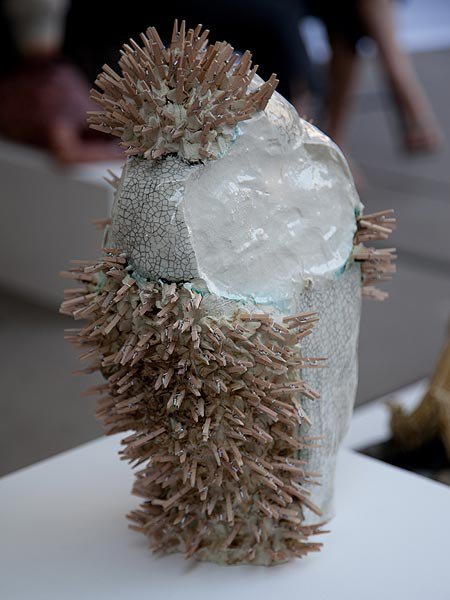
Adam Williams works in clay. These are from a recent outdoor show in Toronto. SEE MOREhere. READ a review of Adam's work, based on one of his annual shows, here. CHECK an interview with the artist here.
Detail from Ebony G. Patterson's The Counting Money HaHa (Counting Lesson Revisited)(2010); mixed media. (Courtesy CRB/NGJ).
"The consensus is that the National Gallery of Jamaica’s Young Talent V survey was a resounding success, marking a decisive shift in artistic ground, not unlike the infamous 1997 Saatchi show Sensation that launched the career of the Young British Artists. "
That is the opening sentence of Annie Paul's review, recently published by the online journalCaribbean Review of Books,of "the latest in a series of exhibitions curated by the National Gallery (of Jamaica) whenever a quorum of noteworthy new talent is aggregated".
The first Young Talent was held in 1985, followed by exhibitions in 1989, 1995, and 2002: "As the catalogue states: “The Young Talent exhibitions have been scheduled whenever the NGJ curators felt that a sufficiently large cohort of promising young artists had emerged to make a strong statement about new directions in Jamaican art." Animage gallery on the CRB's new website gives us a glimpse at some of the incredible work in the show and goes a long way to supporting the opening sentence of Paul's review.
Stefan and Camille (2007), by Marlon James; digital black and white photograph (digitised from negative). Image courtesy the National Gallery of Jamaica/CRB
But, as a friend of mine who recently checked out the show noted, it also makes one begin to wonder: what exactly is going on in the contemporary art scene in Trinidad and Tobago? Where is our 'Young Talent' series? (I am discounting our annual and often productive student shows). In fact, where is our space for contemporary art, period? Jamaica's per capita GDP is US$4,700, Trinidad's is US$18,864--yet the possibility of a show like Young Talent V happening here this decade at the moment seems...out there.
Don't get me wrong, we have young artists. We have people here doing stuff. But where is it? Out there. Somewhere. Where are the institutions to encourage and display and provoke criticism and discourse? What, exactly, is our National Musuem--which, when it's notmoonlighting as a possible administrative headquarters for the Shanghai Construction Group, is often at the mercy of shifting administrations--doing?
In contrast, in Jamaica, judging from Paul's review, they even have room for things like debates about hegemonic artistic classifications into categories like "intuitives":
One drawback of the National Gallery’s conceptualisation of Young Talent is that it allows little room for the inclusion of artists who are neither art school graduates nor sufficiently marooned from art historical “knowledge” to fall into the benighted “intuitive” category. A survey of young talent that overlooks the formidable self-taught polymath Peter Dean Rickards, whose contribution to the visual culture of Jamaica cannot be overemphasised, is missing something crucial, unique, and beyond the rigid scaffolding of traditional art categories. Likewise, I would have expanded the “intuitive” category by including the “sobolious” L.A. Lewis, whose semi-literate graffiti accompanied by his famous tag mark the Kingston landscape as effectively as a male dog marking territory.
It appears as though the Jamaican artists are also embracing the idea of collaboration, something which is not unheard of here, but certainly not common enough:
The artists themselves deserve applause for abandoning the twentieth century preoccupation with “heroic,” individualistic art-making that has such a firm grip on the Jamaican art scene, and engaging in lively conversation with each other. As Poupeye points out in the catalogue, the collaborative approach demonstrated by several artists in the show is unprecedented. This is a group of young artists literally posing for one another, often physically visible in each other’s work, working together instead of against or in spite of each other. Their creativity and productivity are also a tribute to the Edna Manley School of Art, where much of this artistic talent was nurtured.
Artistic talent "nurtured"? "Edna Manley School of Art"? Would be great to have some of that in Trinidad and Tobago. Paul ends her robust review on a thoughtful note:
With their deliberate focus on “the careful craft of showcasing and presenting certain bodies” (shades of L.A. Lewis) — that is, the neglected black body, whether abjectly naked or hyper-accessorised in baroque splendour — artists such as Patterson and Bartley are adeptly shaping a new politics of visibility for the often overlooked or disregarded Caribbean subject.
Some might argue that in Trinidad the artists, themselves "often overlooked or disregarded", must take satisfaction in the sad fact that their marginalisation becomes metaphor for their already marginalised subjects.
***
READ full review at the Caribbean Review of Bookshere.
Absolutely brilliant!!! I've been out of POS for some time and have not yet had a chance to explore this year's EAW but judging from these photos, I'll be doing that over the coming week! CHECK out more photos from ARTSPUB here. DO also check out the Erotic Art Week blog.
Christopher Cozier, Now Showing, (2010), silkscreen on archival paper, 27”x20”
It has the look of a puzzle, some kind of coded message. Apparently incongruous images collide above feet, some bare, some clothed. Enslaved or free?
What might be a plot in a graveyard (the artist sees it also as a car-park) stands alone, next to a large letter A. A grade? A brand? A start? '12.30' oozes red liquid. Is it after midnight or mid-day? A '12.30' show?
Above it all, three key images raise ideological questions and paint impressions of relationships. Prime among them is the tree, inspired by the one at the Forensic Sciences Centre, Port of Spain, where murdered bodies are brought almost daily, where families seek shade. Faint in the background is Clint Eastwood and company. What exactly is showing in this wild wild west?
WATCH a film about the making of this artwork, for the Trinidad and Tobago Film Festival 2010, here. READ the artist's own account of the work here.
Point Galera, Toco. Photo courtesy the Toco Foundation
The participants of this year's Cropper's Writer Workshop will today read poetry and short fiction on Radio Toco live from 2:00 to 2:30 pm, hosted by Wendy Diaz.
Radio Toco is an independent station that broadcasts at 106.7 FM, has 90,000 listeners, and can be heard throughout northeast Trinidad, in Tobago, and by some listeners in the Eastern Caribbean.
Reading today are:
Andre Bagoo: journalist and PLEASURE blogger whose poetry and book reviews have been published in journals such as Boston Review, The Caribbean Review of Books and Draconian Switch.
Shakirah Bourne: an award winning short story writer from Barbados who is not afraid to voice what others try to keep secret.
Shivanee N. Ramlochan: an English Literature teacher from Trinidad who advocates fairness and freedom in life, art and her fiction writing.
Colin Robinson: a Trinidadian writer and community organiser whose work engages political questions of desire, gender and citizenship.
FIND out more about the Cropper's Writer's Workshop here.
From the latest edition of the online journal Caribbean Review of Books, an excellent feature/interview on Karyn Olivier's ACA Foods Free Library project. READ it here.
Hoover Dam, which I visited on a recent US tour, was constructed between 1931 and 1936, and was dedicated on September 30, 1935 by President Franklin Roosevelt. Its construction was the result of a massive effort involving thousands of workers, and cost over a hundred lives. But today it is arguably striking example of function, meets art, meets politics.
READ more about the Hoover Dam here. FIND more posts about a recent US trip here.
Maitreya is the bodhisattva (future Buddha) who may be born on Earth as soon as a few thousand years from now (just around the courner people!) The eight-armed form appears to be a Cambodian invention, but you never know... The above depiction was cast in a period (early 10th century) during which hardly any Buddhist images were commissioned and from which few bronzes survive. One of several extraordinary bronzes that were on display during a recent visit I paid to the Sackler Gallery, Washington.
READ more here. This post is one of a series on a recent visit to the United States. FIND out more here.