art in all its forms

art in all its forms

9/30/10

O'Neil Lawrence spoke last night

O' Neil Lawrence

He co-curated a show called 'Shot in Kingston' at Alice Yard alongside Christopher Cozier. The show explored ideas of a dialogue between Caribbean artists and the possibilities of new digital media which now, arguably, form a new wave of contemporary art.

The event is part of a series of events marking Alice Yard's fourth anniversary. The final event takes place on Friday and is expected to be an interactive one, featuring the Barbadian artist Sheena Rose.

FROM ALICE YARD:

"Barbadian Sheena Rose was artist in residence at Alice Yard in May 2009, when she presented her animated video work Town. She recently participated in a residency and exhibition in Cape Town. Lauren Hinds is a Trinidadian artist working in the medium of the graphic novel. She recently completed a year-long programme at the Centre for Cartoon Studies in White River Junction, Vermont. Rose and Hinds will spend a week working together, then present their collaborative project to the public, together with recent solo works.
8.00 pm"

LINKS: ALICE YARD, SHOT IN KINGSTON

Heino Schmid @ Alice Yard on Sept 27


Still from Equilibrium courtesy Alice Yard

FROM ALICE YARD BLOG:

Heino: “The context of much of my work is concerned with narrative and the reconsideration of personal stories in the public forum. Using a variety of media, such as video, drawing, installation, and photography, I investigate the often simple, sometimes irrelevant encounters and collisions between people and their environments.

“Although I strive for universal metaphors, I approach each body of work in a very personal way. Using self-referential experiences as an avenue to illuminating collective experiences, I hope to reveal the subtle social dramas that inform our lives and ultimately bring those realities to the forefront for discussion.

“The image above (from < (temporary horizon)) combines the use of common material and repetition to candidly examine the shifting tensions between action and inertia, balance and imbalance. The positioning of the two bottles, though fragile and ultimately unsustainable, evokes surprise through its temporary equilibrium, with a false horizon created as a byproduct of this balancing act.”

9/14/10

Happy 4th bday Alice Yard!

Photo courtesy Georgia Popplewell

In the four years that I've been going to Alice Yard, I've seen Dave Williams dance on stilts inside a room the size of a cupboard; committed larceny as blogger Richard Bolai looked on; had mud and dirt thrown at me in the pouring rain amidst shards of glass; eaten lots of tasty corn-soup; made a cone and painted with wax; watched 3 Canal, 12 the band and many more perform; heard poets, photographers and artists talk about their work; seen installations by Elspeth Duncan, Adam Williams and Nikolai Noel to name a few; been literally shocked by a fridge (it was a lawsuit waiting to happen); consumed hundreds of Stags; sipped hundreds of cups of red wine; encountered one very crazy man; met many many beautiful others.

This week marks the fourth anniversary of the Alice Yard space, which has served as an independent-spirited centre for contemporary art in Trinidad. The contribution of this space, at formal, anecdotal and social levels, cannot be underestimated. It has been a place for the arts, in a country where the arts are all too often left bereft.

Almost every week, thanks to the dedication of a team of instigators, there has always been something going on at Alice Yard. This has been no mean feat. And now, to mark Alice Yard's fourth anniversary, a programme, called 4 x 4, has been drawn up by the instigators.

* READ more about the 4 x 4 programme here.


* PLEASURE also today publishes a short story by Cropper Writers Workshop fellow Shivanee Ramlochan, set at Alice Yard, in honour of this vital space. READ it here.

An Alice Yard short story by Shivanee Ramlochan


Them prostitutes outside the gate could write better poetry than me."  

Selah ground her heel into the pavement. I watched the stiletto crush a weed that had pushed through the crack. The gold tip of the heel emerged, crusted in wet dirt.  

"Selah." 

"No, you fuck right off!" She pulled her shoes off and thrust them at me. "I need a cigarette. I need some goddamned weed. Jesus." Selah pronounced the name of the dead saviour like it belonged to a Venezuelan waiter in the Hyatt.  

Photographs courtesy Abinta Clarke

I left her there, went to the corner bar to get a pack of special filters. The gold-tipped heels swung in my left hand. I paid the cashier with a blue note, collected the cigarettes and a sour look. In the corner of the bar, a girl in a leopard-print skirt was gyrating against a painted oil drum. I looked at her for two minutes, watched the curve of her in the dimness, smelt her improbably expensive perfume. I'd bought Selah a bottle of that perfume when her husband had failed to produce a present on their anniversary. It was Selah's favourite. She liked it so much that she had threatened to drink it last week, when Rav announced that he'd be spending August in Cairo

Cairo my fucking Trini-Jamaican asshole, Selah had screamed. Cairo my freshly-waxed salt of the Caribbean earth cunt.  Why he does do this to me, J? Why he does fuck up my fucking life so? 

What the fuck I ever do he? 

My cell phone rang. I shoved the pack of cigarettes into one of the shoes, and answered.  

"Where the fff...nevermind. Get back here, now. Please. I going on in five." 

I stumbled on my way out, heard the oil drum dancer laugh behind me. I wondered whether or not she was laughing at me or at her sad life, her miserable baths in white powder. I remembered the first time I'd told Selah that white powder on the neck was probably not the best look. I was sure she'd deny it now. To see Selah would be to doubt she'd ever stepped foot into - well, the places she avoided like dengue fever now. 

She grabbed the cigarettes out of her shoe before I could hand them to her.  

"I didn't see any prostitutes outside the gate, Sel-" 


She glared, and spat on the pavement. "You're a cunt, J. Trying to fuck up my attempt to get in a better mood. Don't blame me if you end up a bitter unloved queen lesbo." She laughed, presumably at the image it conjured. 

I stepped away from her. The emcee was announcing the order in which the night's poets would present their work. Selah was on second.  

Not even close, I felt like telling her, but instead I said, "You're on second, Selah."

She grinned, handed me her shoes, and skipped up the driveway to the staging area. I watched them watch her. I saw a man gazing at her legs. His look lingered over her unshod feet. I knew she would talk with him, afterwards. He was holding her first collection of poetry in one hand, a glass of white wine in another. He would listen to her, laugh at her politically appropriate banter, and believe her when she said that she always read barefoot when she thought she'd meet someone intriguing. 

I began to think that gold-tipped shoes would look just fine with a leopard-print skirt. 


FIN


***


Shivanee Ramlochan participated in the Cropper Foundation's Residential Writers Workshop in 2010. She is a teacher. 

This will happen at Alice yard


Sean Leonard's original conceptual sketch for Alice Yard

FROM THE ALICE YARD BLOG:

September 2010 is Alice Yard’s fourth anniversary as an independent space for creative experiment. This year we mark the occasion with4x4, a programme of events focusing on Alice Yard’s regional network, and our creative collaborators in four specific Caribbean locations: the Bahamas, Barbados, Jamaica, and Suriname.

= Wednesday 15 September, 2010: Shot in Kingston: The Digital Scene

The exploration of digital photo- and video-based work is a significant recent trend among younger Jamaican artists. Shot in Kingston assembles work by Marvin Bartley, Keisha Castello, Stefan Clarke, Marlon James, O’Neil Lawrence, Ebony Patterson, and Oneika Russell, curated by Christopher Cozier and O’Neil Lawrence.
Exhibition opening 8.00 pm

= Friday 17 September: Alice Yard jam

Alice Yard is an important centre for musical creativity and exchange, offering rehearsal and performance space to numerous bands and individual musicians. Sheldon Holder of 12 the band will curate an acoustic jam session bringing together a number of musicians associated with Alice Yard, in an update of the “Conversations in the Yard” series that ran from 2006 to 2008.
7.00 to 9.00 pm

= Friday 24 September: Outward reach

Alice Yard’s Caribbean network includes independent contemporary art institutions in the Bahamas and Suriname. Artists John Cox ofPopopstudios in Nassau and Marcel Pinas of the Kibii Wi Foundation in Moengo join Christopher Cozier in a conversation about regional collaborations and future possibilities.
8.00 pm

= Monday 27 September: Heino Schmidt: Equilibrium

Bahamian artist Heino Schmidt has been living and working at Alice Yard since May 2010, supported by a Commonwealth Connections International Arts Residency. Equilibrium is a new work created during his time in Port of Spain, also presented at the 2010 Liverpool Biennial.
8.00 pm

= Wednesday 29 September: O’Neil Lawrence on the Kingston scene

O’Neil Lawrence is an artist and curator at the National Gallery of Jamaica. He will give an informal talk on current trends in Jamaica and the artists included in Shot in Kingston.
8.00 pm

= Friday 1 October: Sheena Rose and Lauren Hinds

Barbadian Sheena Rose was artist in residence at Alice Yard in May 2009, when she presented her animated video work Town. She recently participated in a residency and exhibition in Cape Town.Lauren Hinds is a Trinidadian artist working in the medium of the graphic novel. She recently completed a year-long programme at the Centre for Cartoon Studies in White River Junction, Vermont. Rose and Hinds will spend a week working together, then present their collaborative project to the public, together with recent solo works.
8.00 pm

Further details of each event will be posted at the Alice Yard website during the 4x4 programme.

All are invited.

9/12/10

A poem by JG Awai


Even Jesus fell victim to purple rain:
water’s translucent properties sliced
to bring a Canaan feast to life
deep purple resurrected sane.

I was always a purple people eater
myself: lavender, mauve,
magenta, onion, eggplant,
eddoes tender, purple
carotenes, currant-rich
fruity wine.

To think I find myself sinking in brown:
muck, shifting quicksand
beyond Nariva Swamp,
unknown particles
on the back of a shirt collar
that you needed an extra hour
of blue soap and scrubbing
to white out.
I, the gravel’s companion, amidst:
earthworm-laden soil
(riches for Ms.
Eyston’s African roses),
drab solid patterns
of life before Toto
and Dorothy wished
away in a tornado,
rust stuck to the edges
of a toilet rim,
negatives undeveloped
collecting in boxes
and boxes of cobweb
memories and mental clutter,
cockroaches clinging
to florescent light,
spider legs wrapped
around invisible thread,
infertile dried-up seed
in my English teacher
who had 55 students
but no pickney of her own,
workers in the field
blending in
with the plantations,
skin with no chameleon features
(Is she blushing?)
eternal fixtures
with a knick-knack
paddy wack
give a slave a bone
this ole massa
claimed him sold,
pits of underground
cavities and root canals
festering from years
of silence

  (fecal productivity sewers bowels you know the
  shit I’m talking about lifeless uniforms of school
  teacher leave those kids alone paper bag lunches
  with 200 grams of Ritalin-laced goodness wooden
  rule iron fist lesser known ivy league of poisons
  said the Creole You, who penned dart’s mouth
  and yalleed: “Bloody Columbian blue corn,
‘ell have ‘ard no fury like a prince tong!” color
  with  no opacity or meaning to you to me)


*

Brown is:
dried blood on Veronica’s cloth,
cinnamon sprinkled lattes
on a day of due dates,
seeped out cocoa clinging
to callused children’s feet
during the ripening dance,
molasses-rich toolum
that hurts your teeth,
frying pan bottom
sizzling bacon juices
on Saturday morning,
the color of my mother’s thighs
bespeckled with varicose
after years of a kitchen too small
to contain her mastery,
toasty tanned Mexicano brothers
walking like they’ve come
to reclaim their land,
hairy coconut husks
that fall after the wind has its way,
beetles crawling in trenches
with time bombs of history,
Jackie’s revenge--
All colors combined
into a murk of possibilities,
two shades away from my father’s
yellow complexion, or any semblance
that connected him to me.

*

But brown goes deeper:
Elizabeth Taylor’s violet eyes (fake),
that a child craved
and in the process
carved out a face
that might not reflect me.


JG Awai is a post-graduate English student living in New York. She likes fruit smoothies.

9/11/10

Bedside Books


I'm a slow reader and am way behind in my reading. But here is a sneak peek at what's at my bedside these days:

* Crick Crack by Merle Hodge and Summer Lightning by Olive Senior. Two Caribbean classics which everybody should read. I recently finished a writing workshop moderated by Hodge, who is a brilliant writer and academic and is also a social activist. The workshop, held under the auspices of the Cropper Foundation, gave unforgettable insight into the thinking and processes of writers like Hodge. I went back to Crick Crack after the workshop, having learnt a lot about writing and checked it out with a fresh perspective. From the start is it is a novel of understated power and I am looking forward to finishing it.

The first story of the short-story collection Summer Lightning is its title story. A brilliant piece of writing with a wry, wise but dangerous tone. You have the sense that great literature is unfolding before you, like a chill wind that will not relent. Read a full review by Shakira Bourne at Shivanee Ramlochan's blog Novel Niche here.

* Am also checking out: Keep on Running: the Story of Island Records; Midnight in the Garden of Good and Evil by one-time journalist John Berendt; and Elizabeth Walcott-Hackshaw's short-story collection Four Taxis Facing North (which was reviewed here at the Caribbean Review of Books). Here is the first paragraph of Walcott-Hackshaw's short-story 'Here':
There are so many cars ahead of me, even today, Saturday, it’ll be a while before I get the green light and cross the major intersection, so I look to the left for no reason in particular, and I see three boys walking along the side of the highway; the first in what I call cowman boots, black rubber boots, like the ones I wore as a child so that I could pretend to be the man who took care of the cows opposite our first house in the valley; the second boy taller, skinnier, in rubber slippers, his thin T-shirt billowing in the wind like a sail; the third with blue-black madras skin in torn khaki shorts and an oversized white vest, and all three powdered with fine, white sand. They skin and grin, all the while staying in their single file, Indian file, one behind the other, on their side of the highway, the side with the coconut trees, the wooden huts, the razor grass, the rice grass, and everything so green except for the white mosque, crescent moon and star rising out of the water with the billboard: Islam, The Fastest Growing Religion In The World.
This is the work of a strong writer whose sense of language and nuance never overpowers her subject matter. Surely one of the important Caribbean voices out there to watch.

* There is also some poetry at my bedside pile, including: Shell also by the author of Summer Lightning, Olive Senior; Progeny of Air by Kwame Dawes and She Who Sleeps with Bones by Tanya Shirley. Of Senior, who has produced, perhaps more poetry than prose recently, I have to confess I'm developing something of a crush. It started when I encountered her poetry book Gardening in the Tropics online. This is how the opening of the book 'Meditation on Yellow' begins:

          I

          At three in the afternoon
          you landed here at El Dorado
          (for heat engenders gold and
          fires the brain)
          Had I known I would have
          brewed you up some yellow fever grass
          and arsenic

          but we were peaceful then
          childlike in our yellow dawn of our innocence

          so in exchange for a string of islands
          and two continents

          you gave us a string of beads
          and some hawks bells

          which was fine by me personally
          for I have never wanted to possess things


UPDATE: * I am also reading the masterpiece Texaco.


READ more poetry from Gardening in the Tropics here.

Town, Issue 4, has pedigree

Pedigree by Holly Bynoe (2009)

The latest issue of Town, which I am sadly only now getting around to because I have been a very very bad boy these last few months, features work by artist Holly Bynoe and poetry by Agnes Lehoczky and Ishion Hutchinson. READ more here.

9/10/10

Andrea Levy in 'Caribbean Beat'

Novelist Andrea Levy

The latest issue of Caribbean Beat features an interview with British/Jamaican author Andrea Levy on her Booker Prize-longlisted The Long Song:
"With Small Island, I was looking at my parent's generation and their immigration to Britain. And then I wanted to go further into this relationship between Britain and the Caribbean, and of course you come into slavery, and I didn't want to write a book on slavery, because I felt it would be a very difficult thing to do personally, and it's a difficult subject to write about.
"But then, I was at a conference on the legacy of slavery, where a young black woman got up and asked how could she be proud of her ancestry when her family had been slaves. She seemed to be ashamed of this, and I thought what a great shame that was, and I wanted then to tell her a story that would change her mind. So it made me want to tell that story, as opposed to being quite nervous about it."
According to the piece's author David Katz, The Long Song is Levy's most complex:
"The tale Levy has conjured in The Long Song is easily her most complex to date. The plot has many unexpected twists and turns, and although she has incorporated historical events, such as the Christmas Rebellion of 1831, her heroine's voice speaks in opposition to the racist stance of some standard historical works. (The protagonist) July's narrative allows the slaves to reclaim their humanity."
READ more from Caribbean Beat here.

9/9/10

A look back at the film 'Coolie Pink and Green'


"It starts with the image of a woman’s eyes. Then, slowly, dancing plumes of white and pink smoke. Then the woman again, dancing. An opening title tells us the history of the indentured East Indians who came to Trinidad in the nineteenth century. Two narrators — one a young Indo-Trinidadian woman, the other an older man — use sometimes rhyming verse to weave the central conflict that is the subject matter of Coolie Pink and Green: a conflict left unresolved at the end of this poetic short film by the Trinidadian scholar Patricia Mohammed..."

READ the full review at the Caribbean Review of Books' special section on Caribbean film here. FIND out more at the Trinidad and Tobago Film Festival blog here.

9/6/10

On Boscoe Holder's male nudes

Male Nude on Chaise Longue, 1999. All images courtesy of 101 Art Gallery, Port of Spain, Trinidad/NYR Blog.

The late painter Boscoe Holder is known for his famous portraits of black Trinidadian women. But, perhaps, his true legacy lies in his erotically-charged nudes of men, most of which were not publicly exhibited and are, thus, not known to the general public during his lifetime.

The reasons for this are, perhaps, many. Trinidad and Tobago remains in many ways a remarkably taboo-filled society, notwithstanding its cultural rituals which are based on subversion. The idea of the male body being sexual and sexualised in almost the same manner as the female body is, for some, an uncomfortable reality.

Further complications arise given hegemonic notions of sexuality and sexual identity: gay, straight, bi and the normative claims which these paintings are not primarily concerned with in their quest for a truth.

Untitled, 1977

Thus, many of the nudes are quietly held in private collections, for the private pleasure of their owners, much in the way secret longings and desires unfold behind closed doors. As such, the artist Peter Doig has lamented the lack of accessibility to them, in the context of a larger conversation on the lack of proper archiving of art works in this region. (Doig has provoked a response by editor and virtual part-time archivist Nicholas Laughlin).

Trinidad does have a lack of adequate archives for the output of its artists. But of course, this problem is not unique to Trinidad and Tobago. All over the world there are unknown treasures, waiting to be brought within reach of larger audiences. We may complain of the lack of proper archiving of these objects everywhere. For that is the nature of the beast: if not recorded, then how can they be encountered? And how do we know of great work's neglect, if the work is neglected?

Untitled

But let us interrogate this further: if a tree falls in a forest and no one is around to hear the sound, does it make a sound? Does the tree even exist? This is the problem of Plato's allegory of the cave.

Does the fact that Boscoe's nudes are enjoyed in secret mean they do not exist? They have no merit? That they are "undiscovered"--to use that maddening, if not derogatory, term? Did the artist intend these pieces to have a special private relationship with those who see it? Or was he simply caving in to social pressures? Or made uncomfortable by them?  Does the world need to discover all that is hidden? Why? For the democratic spread of beauty? Of culture? Of social commodities? Whose beauty? Whose culture? Whose social commodities? Or is art truth? Are these paintings truth? And thus, a justification in themselves? Then, does truth demand visibility to be true?

The politics of all of this is not simple. And there is no clear answer to any of these issues. For sure the exposure of Holder's work is, in my view, a good thing. But it is not a condition of the truth contained in the work.

Christian, 1976. Typically, only when Holder's male subjects are clothed do they look us in the eye.

And the work is clearly worthy of interrogation and debate.

These paintings are not simply representations of the human body. They are also subtle comments: with delicate elements of surrealism in the way limbs are proportioned just beyond the typical, but not implausibly so: thighs are made larger, arms bend ever so gently in unnatural ways. The issue here is not Holder's technical competence, but rather his feeling that the work was acceptable in its suggestion, if not the subject's form. There is something of Modigliani here. But something completely and utterly Trinidadian, even in its idiosyncrasy.

Also, the men in these paintings rarely stare at us directly. Faces look down, eyes glimpse to the side. When there is a direct gaze, the body is either covered or not visible. When naked and exposed, vulnerability, virility, strength and beauty is mediated, almost, by a kind of reticence: shame or fear or insecurity or insincerity. The tension in the pieces comes not just from their eroticism, but that palpable feeling that the paintings are unfolding behind closed doors. And we, like the painter, are intruding.

8/26/10

Chinese worker by Richard Rawlins

FROM THE ORGANISERS:


Now almost as globally ubiquitous as the “Made in China” stamp, Chinese construction workers are changing the landscape, both internationally and here in Trinidad and Tobago. In his new body of work, artist Richard Rawlins offers a visual commentary on this phenomenon.

Chinese Worker opens at Alice Yard on Thursday 26 August at 7.00 pm, and runs until Saturday 28. The opening night will include a special performance by Dave Williams.

Rawlins says:

“Chinese Worker is another one of my investigations into the things that make us Trinidad. I actually admire what they have done. And, putting all the political footballs aside, we are left with structures that they built almost overnight.  Whether you like it or not, they are now on our landscape, and I think that needs to be recorded.”

About the artist
Richard Rawlins is a visual artist, graphic designer, and photographer. He has worked in advertising for the last twenty years. He is the publisher of the online magazine Draconian Switch. He showed his 2010 Button Project at Alice Yard in May 2010.

===

Alice Yard is the backyard of the house at 80 Roberts Street, Woodbrook, Port of Spain. Since September 2006, Alice Yard has hosted a series of performances, exhibitions, screenings, and other “conversations”, bringing musicians, artists, writers, and audiences together for informal interaction.


CHECK Richard's blog here.
SEE video of Richard here.

8/8/10

FILM REVIEW: Inception


5 stars

Does it have a flaw? Possibly. Probably more than one. But you don't really care by the time you've come out of the cinema. Because you have been blown away.

One of the great things about Christopher Nolan's film is how it so convincingly fuses genres and then wraps itself around the audience like a python: crushing you in a tight coil. The plot is at once classic film noir meets sci-fi meets spy thriller/action flick. The characters are stock, but unforgettable and attractive. The experience, beneath all its hysterical thrills, is profound: it is like an extended meditation on a dream, a startling metaphor for film-making and a deep question about life.

You could read a summary of the plot, but that's not going to help. That said, it is clear that the film is about people stealing ideas by entering dreams. And with that, the intriguing possibility of doing the inverse: implanting ideas to attain certain objectives.

Is this germ not itself a metaphor for the cinema? The film beautifully makes us question the very nature of truth. How do we know that our world is real and not a dream? (The associated question raised by philosopher Robert Nozick's "experience machine"--which was harvested by The Matrix films--is how do we know that our world is not the product of someone else?)

The film's characters figure out an ingenious device for testing reality. But upon deeper thought, that device is clearly also possibly flawed (which is where the tension of the last shot of the movie--in part--originates). What is it that makes us, while we are watching a film, aware that we are watching a film? Why do we jump when we are startled, or scream, or get excited, or get horny, or get anxious when watching what is clearly not real? What is the meaning of the suspension of disbelief and does that suspension not also hold in terms of our attitudes to approaching difficult issues in "real" life?

Okay. Pretty droll stuff there. But the film is nothing like that. Coming out I was left in awe at its power: how it gets you involved. I didn't have the feeling of terror I had when I came out of seeing the first Matrix film (the only decent one). But I did wonder: what the f--k just happened?

UPDATE: I just saw the film a second time and am even now more convinced that this is a great film. This time around, I really appreciated its emotional landscape and how the movie becomes a meditation on one man's guilt and inability to let go of his past. 


Notably, the performance by Marion Coutillard is incredible (all the other actors are also strong). Coutillard is at once dangerous, alluring and unforgettable: a real femme fatale in the finest traditions of the noir, but with an edge and intensity that the story permits but does not quite explain. 


Additionally, I was also struck by the screenplay, how economically Nolan made important points and got the action flowing. Take for example the masterful scene when we meet businessman Robert Fischer (played by Cillian Murphy). We see Fischer from behind, his face a silhouette. His dying father throws a childhood portrait of Fischer to the floor and Fischer is literally picking up the pieces when he utters his first line. His father didn't even notice the picture, he says. Immediately, Nolan has fixed this character: it is understood that his troubled relationship with his dad has, in many ways, come to define him.


And while I noticed it the first time around, the second time really made me appreciate the intricacies of Hans Zimmer's score. Each character has a different musical motif: Fischer's is dark, brooding and suggestive of his conflict with his father. So too is the theme for Coutillard's character.


Yes, yes, the logical flaws, this time around, were more obvious. They did not diminish the film for me though, because before you know it, the movie has earned its keep.

*


FOR a humorous take on Inception, you should watch this video (BUT ONLY AFTER YOU'VE SEEN THE MOVIE!) CHECK this one too.

8/6/10

Pieces of Adam Williams in Toronto


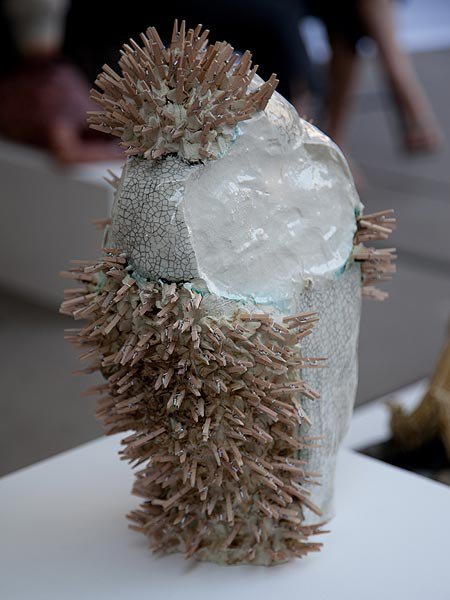
Adam Williams works in clay. These are from a recent outdoor show in Toronto. SEE MORE here. READ a review of Adam's work, based on one of his annual shows, here. CHECK an interview with the artist here.

***

8/3/10

Jamaica's 'Young Talent V' show raises questions for TT

Detail from Ebony G. Patterson's The Counting Money HaHa (Counting Lesson Revisited) (2010); mixed media. (Courtesy CRB/NGJ).


"The consensus is that the National Gallery of Jamaica’s Young Talent V survey was a resounding success, marking a decisive shift in artistic ground, not unlike the infamous 1997 Saatchi show Sensation that launched the career of the Young British Artists. " 

That is the opening sentence of Annie Paul's review, recently published by the online journal Caribbean Review of Books, of "the latest in a series of exhibitions curated by the National Gallery (of Jamaica) whenever a quorum of noteworthy new talent is aggregated"

The first Young Talent was held in 1985, followed by exhibitions in 1989, 1995, and 2002: "As the catalogue states: “The Young Talent exhibitions have been scheduled whenever the NGJ curators felt that a sufficiently large cohort of promising young artists had emerged to make a strong statement about new directions in Jamaican art." An image gallery on the CRB's new website gives us a glimpse at some of the incredible work in the show and goes a long way to supporting the opening sentence of Paul's review. 


Stefan and Camille (2007), by Marlon James; digital black and white photograph (digitised from negative). Image courtesy the National Gallery of Jamaica/CRB


But, as a friend of mine who recently checked out the show noted, it also makes one begin to wonder: what exactly is going on in the contemporary art scene in Trinidad and Tobago? Where is our 'Young Talent' series? (I am discounting our annual and often productive student shows). In fact, where is our space for contemporary art, period? Jamaica's per capita GDP is US$4,700, Trinidad's is US$18,864--yet the possibility of a show like Young Talent V happening here this decade at the moment seems...out there. 

Don't get me wrong, we have young artists. We have people here doing stuff. But where is it? Out there. Somewhere. Where are the institutions to encourage and display and provoke criticism and discourse? What, exactly, is our National Musuem--which, when it's not moonlighting as a possible administrative headquarters for the Shanghai Construction Group, is often at the mercy of shifting administrations--doing? 

In contrast, in Jamaica, judging from Paul's review, they even have room for things like debates about hegemonic artistic classifications into categories like "intuitives":
One drawback of the National Gallery’s conceptualisation of Young Talent is that it allows little room for the inclusion of artists who are neither art school graduates nor sufficiently marooned from art historical “knowledge” to fall into the benighted “intuitive” category. A survey of young talent that overlooks the formidable self-taught polymath Peter Dean Rickards, whose contribution to the visual culture of Jamaica cannot be overemphasised, is missing something crucial, unique, and beyond the rigid scaffolding of traditional art categories. Likewise, I would have expanded the “intuitive” category by including the “sobolious” L.A. Lewis, whose semi-literate graffiti accompanied by his famous tag mark the Kingston landscape as effectively as a male dog marking territory. 
It appears as though the Jamaican artists are also embracing the idea of collaboration, something which is not unheard of here, but certainly not common enough:
The artists themselves deserve applause for abandoning the twentieth century preoccupation with “heroic,” individualistic art-making that has such a firm grip on the Jamaican art scene, and engaging in lively conversation with each other. As Poupeye points out in the catalogue, the collaborative approach demonstrated by several artists in the show is unprecedented. This is a group of young artists literally posing for one another, often physically visible in each other’s work, working together instead of against or in spite of each other. Their creativity and productivity are also a tribute to the Edna Manley School of Art, where much of this artistic talent was nurtured.
Artistic talent "nurtured"? "Edna Manley School of Art"? Would be great to have some of that in Trinidad and Tobago. Paul ends her robust review on a thoughtful note: 
With their deliberate focus on “the careful craft of showcasing and presenting certain bodies” (shades of L.A. Lewis) — that is, the neglected black body, whether abjectly naked or hyper-accessorised in baroque splendour — artists such as Patterson and Bartley are adeptly shaping a new politics of visibility for the often overlooked or disregarded Caribbean subject.
Some might argue that in Trinidad the artists, themselves "often overlooked or disregarded", must take satisfaction in the sad fact that their marginalisation becomes metaphor for their already marginalised subjects.

***

READ full review at the Caribbean Review of Books here.